Showing posts with label ANALYTICAL ESSAY. Show all posts

Thursday, October 16, 2014

THE BOOK THIEF - MARCUS ZUSACK - ANALYTICAL ESSAY

Brutality and Beauty are both aspects of the human spirit and therefore are evident in society and have been through the ages. History can be examined to bring forth examples of both, often side by side, often in times of great destruction such as in times of war. In the novel, The Book Thief, Marcus Zusak explores and compares the juxtaposition between great brutality and beauty in the human spirit evident in the German town of Molching during WW2. The author demonstrates how the characters in the novel can overcome cruelty and ruthlessness with acts of extraordinary kindness and humaneness. This is shown through the novel with Max and Liesel’s friendship, when Hans gives one of the Jewish camp prisoners a piece of bread and when Rosa and Hans protect Max from the Nazis. Zusak illustrates that a human’s capacity for hope is difficult to destroy regardless of the circumstances.

Throughout The Book Thief, Max and Liesel’s friendship is developed amidst war and suffering. Given the circumstances of the time and Max’s background, they still manage to develop a special bond between the two of them. This is made evident several times in the novel including when Max gives Liesel the book, The Standover Man for her birthday. This story that Max writes himself defines the significance of their friendship, as he says in the story; ‘Now we are friends, this girl and me’. He illustrates and expresses his love and friendship with Liesel by comparing their dreams with each other as they have both have this in common. It also allows Max to ‘understand that the best standover man I’ve known isn’t a man at all...’, so his friendship with Liesel helps him uncover things he wouldn’t have been able to without her. Furthermore, the message that Zusak is trying send is that friendships can still be made no matter what the circumstances are.

Zusak shows that regardless of the cruelty and brutality of humanity, beauty can always overcome brutality somehow. This is evident when Hans gives one of the starving Jewish camp prisoners a piece of bread when they are marched through Molching on their way to the Dachau death camp. When Hans ‘held his hand out and presented a piece of bread, like magic’ to the Jew it symbolises the beauty amongst all the war and suffering. This was a very risky decision that Hans made and despite the fact that he regretted it afterwards and asked himself ‘what was I thinking?’. Hans was possibly more concerned with the danger to which he had exposed his wife Rosa and his ward Liesel. Such a character as Hans was not concerned with his own safety even in the face of the brutality of the German prison guards.

Offering asylum to a Jew during the time of the Holocaust was what some would see as either an act of great bravery or great stupidity. Hans owed the Jew Max's father a great favour accrued in WW1. Hans had always promised to repay a debt, and thus Max arrived on his doorstep in his attempt to avoid being sent to a concentration camp in Hitler's campaign to rid Europe of Jews so the Aryan race would not be sullied. The Hubermanns offer Max love and friendship in contrast to the hatred the general populace shows Jews in response to Hitler's edicts. in Rosa accepts Max without considering turning him away. Even though her character is presented as brusque, foulmouthed and impatient, she has a good heart. Sheltering Max puts the whole family in danger of being shot as traitors, but Max lives as comfortably as possible in the freezing basement, never venturing outside except if the air raid siren goes off. In 1933, 90 percent of Germans showed unflinching support for Adolph Hitler. That leaves 10 percent who didn't. Hans Hubermann belonged to that ten percent. (10.9) The beauty of this harbouring of a Jew in the time of the Holocaust was an act of breathtaking bravery in the face of Nazi brutality, showering hope on Max who was in a hopeless situation.

Markus Zusack demonstrates how the characters in The Book Thief overcome cruelty and ruthlessness with acts of extraordinary kindness and humaneness. Max and Liesel’s friendship is heartwarming in the face of the brutality occurring outside the relative safety of the basement. Hans' extraordinary act of kindness in the face of great danger when giving one of the Jewish camp prisoners a piece of bread and showed great beauty in the face of great brutality. It was a kind act punishable by death, but Rosa and Hans protect Max from the Nazis. In his novel, Zusak illustrates that a human’s capacity for hope is difficult to destroy regardless of the circumstances. As the narrator Death himself says that humans are capable of both brutal and beautiful things.

This essay does not generally have referenced quotes. You will need to find some for your essay.

This essay is compiled using Anti Essay and Denise Covey's input. 

http://www.antiessays.com/free-essays/The-Book-Thief-87478.html


Tuesday, October 7, 2014

THE BOOK THIEF - MARCUS ZUSACK - ESSAY - DEATH AS NARRATOR

Essay on The Book Thief by Markus Zusak
Teacher: Adrienne Buckingham of Otago Boys' High School


In the novel The Book Thief by Markus Zusak, the narrator who is known only as ‘Death’ is a critical thinker which makes Death’s point of view very engaging for a modern audience.  Death tells the story of Liesel, an ordinary German girl living in Germany during World War Two.  Death’s point of view is very engaging for a modern audience because he provides his own insights and observations about humanity and tells the story from a German perspective rather than an Allied perspective, which is what we are used to reading.

Through his insightful narration, Death conveys to us Zusak’s idea of the duality of humanity.  One of the main ideas within this idea is that of the beauty in ugliness.  This idea is best shown to us through Liesel’s best friend, a young man named Rudy Steiner.  Rudy is the perfect physical example of a Nazi; he has “beautiful blond hair and big safe blue eyes” and he is a fine athlete.  However, mentally he hasn’t got a Nazi moral in him.  Zusak tells us this through Rudy’s actions.  When the Jews are being paraded through Molching (where Rudy and Liesel live) to the death camp, Dachau, Rudy puts bread on the road for the Jews to eat, even though this is very dangerous and he is starving himself.  This small act of kindness is a beautiful act in the ugly world of Nazi Germany.  Death foreshadows Rudy’s untimely demise by saying “he didn’t deserve to die the way he did.”  Zusak is using Death as a narrator to make insightful judgements of human’s character through their actions to portray the idea of beauty in ugliness.

The triumph of love over hate is another part of the duality of humanity which Zusak uses Death to show.  This idea is best portrayed to us through the relationship of Liesel and Max, a Jew who Liesel’s foster parents, the Hubermans, take in and hide in their basement during the Holocaust.  In Nazi Germany at the time, their relationship is very much illegal due to the antisemitic  laws and views of Nazism.  However, it is this hate and oppression which brings them together and helps to develop the love between them.  Zusak uses two events to really show us the strength of their love.  The first is when Max is being marched through the main street of Molching on his way to Dachau after being caught.  Liesel spots him in the crowd, and despite the danger of even waving to him, she runs out and hugs him.  “Her feet heavier than they had ever been before, heart swelling in her chest, she stepped onto the road.”   Zusak uses this act to show that sometimes the pull of love is far stronger than the fear of any punishment.  The second event is when after the war, Liesel is working in a shop and a man comes in looking for her.  She comes out and sees Max and in the words of Death “They both fell to the floor, and hugged and cried.”  Through the narration of Death, Zusak shows us that Max somehow managed to survive Dachau.  Zusak is suggesting that the power of Liesel’s love was enough to overcome the hate of Nazism and gave Max the strength to survive. 

Death tells the story of World War Two from the perspective of a German civilian which is very different because we are so used to hearing the story from an Allied point of view.  This critical perspective makes the story even more engaging for a modern audience as Death gives us a look into a side of the war we have not really seen before.  In one of Death’s asides throughout the novel, he states “I have observed and been horrified by humans.”  This statement captures our attention because normally humans theorise about, and are horrified by, the thought of death.  Zusak has Death say this shocking statement to convey the reality of World War Two.  Not only was it the Nazis, Allies and the Jews who suffered terribly during the war, but it was also the civilians and the people left behind after loved ones had died.  Liesel is a perfect example of the ordinary civilian who doesn’t support the Nazis but has got caught up in their war.  At the start of the book, she loses her brother and is adopted by a new family.  Then when Himmel Street is bombed, she loses just about everyone she loves.  Death illustrates to us the pain and even the survivors guilt that this causes: “It was the survivors I couldn’t stand to look at… They had torn hearts.  They had beaten lungs.”  Through Death, Zusak shows us a side of the pain which war causes that is often overlooked, but which can be worse than dying itself.  Zusak also reminds us that this pain was not limited to the Allies who had lost loved ones, but was just as relevant in the heart of Germany.


In conclusion, the narrator must be a critical thinker if the point of view of the text is to be engaging for a modern audience.  Death as a narrator is a critical thinker who Zusak uses to portray the idea of the duality of humanity and to show us a part of the war which is rarely presented to us.   

http://englishonline.tki.org.nz/sympa/archive/secondaryenglish/2011-11/msg00017/Essay_on_The_Book_Thief.doc

Tuesday, September 9, 2014

MACBETH - SHAKESPEARE PLAYS - THEMES - EVIL

QUESTION: Who is the most evil character in Macbeth--Macbeth of Lady Macbeth?

RESPOND in analytical essay (PEEL) style.

Not all quotes are referenced. You can look them up yourself!!

YELLOW - broad statement on the topic
BROWN - general statement on the topic
GREEN - plot summary
PINK - thesis
 BLUE - arguments (3) using characters (3)
LINK: link to thesis

In the 15th Century play, Macbeth by William Shakespeare, there are many expressions of evil, but evil is mostly expressed in the characters Macbeth and Lady Macbeth. It is often debated which of the Macbeths was the most evil. At the beginning of the play Macbeth appears a brave soldier, loyal to King Duncan, while Lady Macbeth appears the more evil of the two, overstepping her role in the Great Chain of Being, pushing Macbeth to  murder the king. However, events unfold which reveal that Macbeth is the most evil character in the play, degenerating from the time of the witches' prophecies due to his "vaulting ambition". Once Macbeth hears the witches' prophecies, he vows to murder King Duncan, then Banquo, his best friend must die because of the succession to the throne, then his evil reaches its zenith when he arranges the murder of the good wife, Lady Macduff and her children.

POINT: 
When the play begins, Macbeth appears a brave character who is loyal to his King and cousin, but not for long.  When he meets the weird sisters on the heath when returning from battle, they promise him he will become Thane of Cawdor, then the King hereafter. He sends a letter to Lady Macbeth, telling her of the "fateful news." It is his wife who encourages him to go through with King Duncan's murder, goading his masculinity. He probably would not have killed the king without his wife pushing him, although he admits to "vaulting ambition". Macbeth equivocates, then falls in on fate's side, blaming the "...dagger, which I see before me..." (1.6...) Once he kills the king, even though at first repentant, wishing he could wake King Duncan, he continues on his murderous rampage. He no longer tells his wife of his plans, protecting his "dearest chuck". From this point on, once partners in crime, Macbeth now appears the most evil character of the two, relegating his wife to the subservient position expected of women in Elizabethan times.

POINT: 
Once King Duncan's murder is achieved and Macbeth is crowned king at Scone, he is not content. As the weird sisters prophecied to Banquo that "Thou shalt get kings, though thou be none." (1.3.68) Macbeth feels insecure in his position as he feels it is pointless that he has killed the rightful king just so Banquo's sons can inherit the throne. Macbeth does not carry out the murders himself, instead his evil heart plans it; he hires three murderers to do the deed, first blackening Banquo's name to them. He says of his best friend: "Banquo, thy soul's flight, If it find heaven must find it out tonight" (3.1.62-63). Banquo is killed, but Fleance flees, so Macbeth cannot relax in his kingly position. At this stage of the play, evil still drives Macbeth's actions, and he sees the ghost of Banquo at the feast, revealing his guilty conscience at murdering his friend. Lady Macbeth spends the night covering up for her husband's shattered mental state, as Macbeth is the only one who can see the ghost of Banquo. Lady Macbeth protects Macbeth by sending the lords home before Macbeth can reveal his evil acts to them all.

POINT: 
By the time Macbeth decides to kill Lady Macduff due to his suspicions of her husband who has flown to England, he is a seasoned murderer, moving from evil act to evil act. Lady Macduff, although warned of pending disaster, holds her ground, stating "Whither should I fly? I have done no harm." (4.2.82-83) That Lady Macduff is an innocent does not stop Macbeth from sending murderers to kill her and her children. He has become, as Macduff says to Malcolm, "treacherous". Malcolm replies "Macbeth is a tyrant" (4.3.20-21). Macduff, even before hearing that Macbeth has killed his family says, "Not in all the legions of horrid hell can come a devil more damned In evils to top Macbeth." (4.3.63-65).

Macbeth, the play personified evil through the characters of Macbeth and Lady Macbeth. Once Macbeth murders once, he goes on a rampage unassisted by his wife. Perhaps his most evil act is killing Lady Macduff and her children. When he faces Macduff on the battlefield, he expresses some regret at the evil act. Macduff calls Macbeth a "Hell-hound" (5.8.4) and that is the way Shakespeare crafts his character through the play. Therefore, Macbeth is the most evil character. After her initial involvement in King Duncan's murder, Lady Macbeth deteriorates into madness, shocked at her husband's murderous rampage.

Thursday, August 28, 2014

MACBETH - SHAKESPEARE - ESSAY ON THEMES - FAIR AND FOUL, TRAGIC HERO, INTERNAL CONFLICT, THE SUPERNATURAL

One of the most important themes in Macbeth involves the witches' statement in Act 1, Scene1 that "fair is foul and foul is fair." (Act 1, Scene 1, Line 10) This phrase aptly describes the macabre status quo within the character of Macbeth and without.  When Macbeth and Banquo first see the weird sisters, Banquo is horrified by their hideous appearance.  Conversely, Macbeth immediately began to converse with these universally known evil creatures.  After hearing their prophecies, one can say that Macbeth considered the witches to be "fair" when in reality their intentions were quite "foul." Macbeth's possession of the titles of Thane of Glamis, Thane of Cawdor and King of Scotland came by "foul" means.  Macbeth became the Thane of Glamis by his father Sinel's death; he became Thane of Cawdor when the former namesake was executed for treason; and he was ordained King of Scotland after murdering the venerable Duncan.  Thus, Macbeth had a rather ghastly way of advancing in life.

This theme is further verified by King Duncan's statement "There's no art/ To find the mind's construction in the face." (Act 1, Scene 4, Lines 11-12) Although Macbeth has the semblance of the amicable and dutiful host, ("fair") he is secretly plotting Duncan's death ("foul").  Furthermore, Lady Macbeth's orchestration of the murder exemplifies the twisted atmosphere in Inverness Castle.  Both a woman and a host, she should be the model of grace and femininity as described by King Duncan.  She is also described, however, as a "fiendlike queen" (Act 5, Scene 6, Line 69) and exhibits a cold, calculating mentality.  In addition, the very porter of Inverness likens the place to the dwelling of the devil Beelzebub.  This implies that despite its "pleasant seat," as described by the king (Act 1, Scene 6, Line 1) Inverness is a sinister and evil place.  It is also interesting to note that Macbeth is unable to say a prayer to bless himself after murdering Duncan.  It is strange and "foul" that he should think of religion after committing such an unholy act.  The very sanction of sleep and repose is also attacked in Macbeth.  What is normally considered a refreshing and necessary human activity is "murdered" by Macbeth after he commits his heinous crime.  Neither Macbeth nor his wife is able to sleep after killing Duncan. 

Macbeth's lack of sleep turns him into a brutal killer; Lady Macbeth begins to sleepwalk and inadvertently reveals the source of her distress through her nightly babble which is overheard by the Gentlewoman and then the Doctor.  In addition, Macbeth gains an almost inhuman strength and courage after his first crime.  He is more courageous in crime than he has ever been in virtuous deed, which is indeed bizarre.

A second theme in Macbeth is that of the tragic hero.  A tragic hero is a character that the audience sympathizes with despite his/her actions that would indicate the contrary.  Macbeth, in spite of his horrible murders, is a pitiable man.  His saving grace is that he did not initially want to kill Duncan but later changed his mind after listening to his wife.  In addition, Macbeth internally suffered because he could not enjoy his royal status.  Fear, paranoia, exhaustion and sleeplessness plagued him despite his sovereignty.  Lady Macbeth is also a tragic hero.  Her initial courage and daring did not last long, and she quickly deteriorated into a delusional, hapless somnambulist.  She broke down mentally and physically because of the strain of the crime.  Macbeth and his wife are pitiable characters because the reader is able to follow their every thought and action.  Thus, the reader sees not only their gruesome effects on the Scottish people but also on themselves.

Another important theme in Macbeth is that of indecision and internal conflict.  Macbeth was indecisive up until the very night of the murder about whether or not he should kill Duncan.  Afterwards, he was unsure of a course of action and would like to have undone the foul deed.  He rashly decided to kill Banquo, visit the witches and remain confident even when his castle was besieged.  Lady Macbeth's initial lack of indecision is what brought about the pair's downfall.  Later, however, she becomes tentative about the potential benefits of Banquo's murder.  By the end of the play, she has become a delusional recluse that is almost entirely ignored by her husband.

A fourth important theme in Macbeth is the creation of an internal/external hell.  This creation of a place of damnation begins when Macbeth freely converses with the sinister witches.  Banquo calls the weird sisters "instruments of darkness," (Act 1, Scene 4, Line 124) but Macbeth still decides to take their advice.  Several times in the play both Macbeth and his wife invoke the night, a universal symbol of evil and darkness.  Furthermore, many of the scenes in the play take place at night or in murky areas and are accompanied by the shrieks of ominous animals.  Macbeth is unable to bless himself after the crime and he "murders sleep," (Act 2, Scene 2, Line 35) one of the only positive associations with night.  Thus, hallucinations, sleepwalking, disembodied voices and ghosts all pervade Inverness.  One can recognize the climax of this creation of an external hell when the porter himself likens the castle to the residence of the devil.  Furthermore, Macbeth is indirectly compared to Edward the King of England.  Whereas Edward cures people, Macbeth kills them.  In addition, Lady Macbeth commits suicide in the castle, an act considered worthy at the time of eternal damnation in hell.

This creation of an external hell also corresponds to Macbeth and Lady Macbeth's internal suffering.  Macbeth is never at peace after the murder of King Duncan - he is either delirious, enraged, brutal and/or paranoid.  He cannot enjoy the material and mortal pleasures of being a king despite all of the sacrifice that it took on his part.  Lady Macbeth's courage and resolve quickly deteriorates and she is left as an incurable somnambulist who unconsciously tries to erase her memory of the crime.  Macbeth and his wife's unintentional creation of an external hell for Scotland is pitiable because they suffered internally as well as externally.

http://www.novelguide.com/macbeth/theme-analysis

Thursday, July 31, 2014

JASPER JONES - CRAIG SILVEY - ESSAY - MARGINALISATION


Jasper Jones Essay 


The novel, ‘Jasper Jones’, is set in a small country town in outback Australia in the 1960s.  The setting was influenced by novels that Silvey, the author had read as a youth. Such as To Kill A Mocking Bird, The Adventures of Huckleberry Finn, and One Flew Over The Cuckoo’s Nest. people from this same hot desert climate and who have a decent  knowledge of past events and times can really get into the book, as you can see the different perspectives of each character living in that time and place.
The Bucktin family is an excellent example of this. The town sees this family as a normal family, with Charlie’s dad working , his mum staying at home and Charlie doing as he is told.  This is how they want to be seen so they don’t get frowned upon by the townspeople. On the inside though the family was holding together by a string.  Charlie’s mum is really unhappy living in Corragin, the dad only stays with her for Charlie’s benefit. Mum was only in it because in the 1960’s it was frowned upon to get a divorce and she really only cared about her image in town.
This small town ideology of the 1960s really shaped the way the Bucktin family acted and how many of the other families in that small town also acted. Although the time and setting affected the Lou’s in a bad way because of their Vietnamese background. During the time the book was set the Vietnam War was happening, and some of the local Corrigan residents had been sent to fight over there. The Lou’s were not only picked on but marginalised by most of the town. Sue Findley was one of those people as she blamed Mrs Lou for the death of her husband in Vietnam, because she was Vietnamese. The family was also blamed by some of the young men that had lost their jobs at the local mine – the same mine that was sponsoring the Lou’s to be able to live in Australia.  They blamed them purely because of their background and the fact they were Vietnamese.
Jasper Jones was also marginalised because he was a half cast. This really affected him more because the author put him in the 1960’s and black people were set aside as the ‘others’, they weren’t seen as real people but blamed if anything was to go bad.  His father didn’t help Jasper so he was forced to take control of his own life, as there was no support like Centrelink back in the 1960’s. But Because of his father’s bad parenting Jasper Learned morels about looking out for himself. Because of this Jasper made his own hide-out and when he found Laura dead there he had no choice but to hide the body. Otherwise, because of the way the townspeople viewed him, he would be blamed for her death without question.
The only reason Charlie helped Jasper was because of the way his Dad raised him, letting him read novels with good beliefs and values. These novels are also the novels that the author, Silvey read that had influenced his writing of the book. These novels shaped the way Charlie thought and how he reacted to certain events through the novel. Often he would refer to a character in one of these books, like Atticus Finch – “What would Atticus Finch do?” Charlie Bucktin. The thoughts allowed Charlie to better handle the situations that he and Jasper were placed in throughout the novel and the different circumstances that affected him.  The lack of proper detectives and the absence of modern technologies such as DNA testing, affected how Jasper and Charlie dealt with Laura’s murder, from the beginning of the novel. As Jasper would have been blamed for the murder of Laura, because the town hated him and the only evidence (the location of the body), this stopped Charlie from going straight to the police for help and instead decided to solve the mystery and help Jasper, like his dad did when he helped the Lou’s when some locals destroyed there beautiful garden.
All the characters in this novel, Jasper Jones, are affected differently by the author’s setting in a small town in the 1960’s.  Characters that are different such as the Lou’s and Jasper are marginalized, and families like the Bucktins to act in a certain way and would have been frowned upon by the community if they weren’t the communities idea of a family. All these characters would have had very different lives if placed in the present day. But its this allowence for the time that gives us a real connection to the charcters.

http://sheldonikin.wordpress.com/2013/05/19/jasper-jones-essay-by-sheldon-ikin/

Wednesday, June 11, 2014

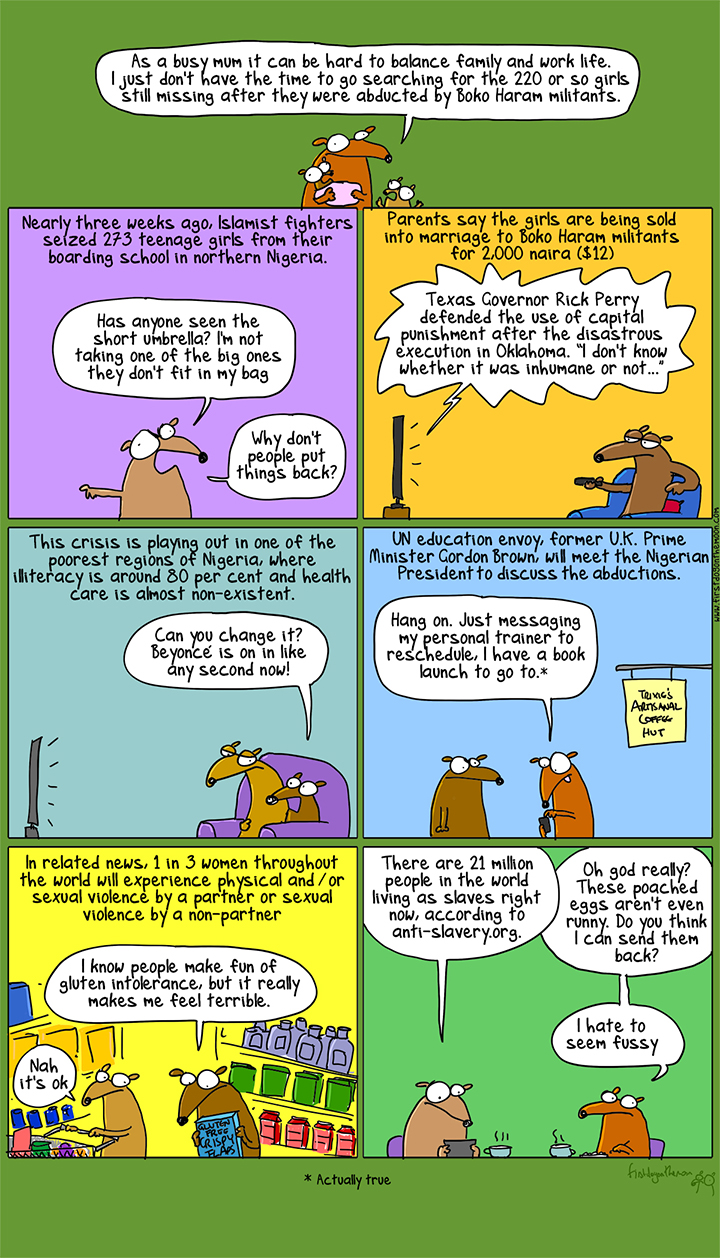
SATIRE - FIRST DOG ON THE MOON - NIGERIAN ABDUCTED GIRLS - ANALYTICAL ESSAY


How has the satirist used visual elements and language techniques to convey the message in this cartoon?

There is a world of difference between First World countries and Third World countries. First World countries control most of the world's resources, but do not see the need to empathise with Third World societies. It is becoming a commonplace saying today - 'That's a First World problem,' when people from rich nations complain about everyday 'issues' that displease them, not seeing that in comparison to Third World populations, their problems are small indeed. Take the recent abduction of 273 Nigerian schoolgirls, whose only crime was desiring an education, something taken for granted by First World populations. The media showed scant interest at the time in following this story, no First World governments demanded action to bring back the girls, and the story soon became forgotten. It is an unhappy fact that these girls are still missing, still to be returned to their families, still to be certified dead or alive. Yet the First World has all but forgotten them. Satire is a form of comedy that uses wit as a weapon to send a message to society, in this case, First World society. The satirist in the 'First Dog on the Moon' cartoon has mocked this situation by the clever use of satirical devices such as visual elements and language techniques, targetting First World society which does nothing, or very little, to assist Third World society. Visual elements such as juxtaposition and caricature have been used in each frame and language techniques such as verbal irony are evident in the text within the cartoon frames. The purpose of combining all these elements is to send the message that First World people need to use their resources to reach out to Third World people.

The visual element of juxtaposing First World problems and Third World problems side by side, the satirist has enhanced the message in the text that is - First World problems are very insignificant when compared to Third World problems. At the top of the first two frames are words stating the facts about the 273 Nigerian schoolgirls who were abducted, whilst underneath the 'news', is the 'dog' (representative of First World children) complaining about an umbrella. 'Why don't people put things  back?' is asked regarding the umbrella. Very much a First World problem when Nigerian families are asking 'Why don't they bring our girls back?' The priorities of First World populations is shown in the second frame where one of the small 'dogs' is asking for the news of the Nigerian girls to be turned off as he/she wants to watch Beyonce on television. This juxtaposition reveals the lack of interest in the abducted Nigerian girls. By the third frame, the readers get the message - no matter how brutal are the facts about Third World problems - 21 million in slavery is a big deal - in the First World how the eggs are done is more problematic. The satirist has cleverly used the visual element of juxtaposition to mock the follies and vices of First World populations who show little interest in the terrible situations people in Third World countries are experiencing right now.  

Caricature is a crucial visual element of satire. The exaggeration of situations and characters help to give the satirist's message more impact. The representation of the First World as 'dogs' could be seen as derogatory, as to call a person a 'dog' is a huge put down. It could be classed as a way to mock First World children. The caricature of these cartoon figures is effective, and much kinder than a realistic representation of people would have been. By using the 'dogs' to represent First World children, maybe the cartoonist was hoping to be less offensive, and therefore people would study the cartoon more closely. The big eyes could represent knowledge while the long noses often represent liars, derived from the Pinocchio story. By representing real-life situations in caricature, the author has gauged the impact of his message that First World people really do not care about Third World problems, no matter how dire these problems are. 

Verbal irony, a language technique,  is perhaps one of the strongest tools of satire and it is present in this cartoon. The type of verbal irony used in this satirical cartoon is one where comparisons and contrasts are used to create a visualisation for the reader. Throughout each cartoon frame, the satirist has positioned the reader to compare First World concerns with Third World concerns, with the result that the reader should see as vacuous any comments by the First World 'dogs'. It is ironic that in the first frame, the 'dog' is whining about his umbrella, where in a country that would dearly love to see rain, an umbrella would not be used. People would be outside lapping up the rain. It is also ironic that the same 'dog' should ask the question - 'Why don't people put things back?' Of course the reader thinks of the 273 Nigerian girls who haven't been 'put back' where they were found. It is a well-known fact that Beyonce is very important to teenagers in the First World. She has many fans and one can understand the First World child wanting to watch her on television. It is ironic that watching Beyonce is far more important than hearing the news about what is happening to the Nigerian girls and how many real problems the Nigerian children have - widespread illiteracy and virtually no health care. In the third frame, the 'dogs' are discussing 21 million people enslaved globally, yet the smaller 'dog' is only concerned with the status of his eggs - 'Do you think I can send them back?' This is of relatively little importance and very ironicaly when we think about the Nigerian girls who haven't been sent back home.

The satirist has conveyed a very strong message by comparing First World problems with Third World problems. The First World is the obvious target of the mocking satire which exposes the follies and vices of First World people who are represented as dogs. The visual elements and the language features underline the message in the cartoon. What can First World children learn from a cartoon such as this one? Perhaps remember that you are very privileged and be grateful for your good fortune in living in a First World country rich in resources, rather than in a Third World country which lacks even basic resources such as education, health care, water and most of all, freedom. If you are able, donate some money to alleviate their problems.  


Some suggestions if you want to help:

What To Do:
1. Remember your privilege and be grateful for your good fortune.
2. Speak about this and other uncomfortable topics.
3. Don't get sucked in to the bullshit that is broadcast nightly (usually around six o'clock).
4. Write to your local MP; tell them this topic is important to you.
5. Find out who is doing something about this; offer them a one-off donation.
6. Feel better for having done something.
7. Don't feel so overwhelmed that you can't do anything.
8. Get involved in a local group that does something constructive in your area.
9. Be kind.

http://www.theguardian.com/commentisfree/cartoon/2014/may/05/first-dog-nigeria-girls

RESPONSE: How does the cartoonist convey the message?

  • Who is the target?
  • What is the purpose?
  • What language techniques does the cartoon contain?
  • What visual elements does the cartoon contain?

Tuesday, June 10, 2014

THE MERCHANT OF VENICE - ANALYTICAL ESSAY - THE COURT SCENE

How does the trial scene in The Merchant of Venice demonstrate the triumph of good over evil as order is restored from chaos.

SOME BACKGROUND ON THE MAIN ASPECTS OF THE TOPIC, THEN...

The trial scene in the Merchant of Venice is the chaotic climax of the play as Shylock, the Jew, has 
taken Antonio to court, as due to losing his ships, he has not paid back the money he borrowed to assist his best friend Bassaino's wooing of Portia of Belmont.  Even though there are those in the court willing to pay back the bond triple fold, Shylock wants the pound of flesh that is the forfeit of the bond concerning the money Antonio borrowed from him.  Other than his hatred for Antonio and Christians, Shylock’s main motivation for wanting this forfeit is as his daughter has stolen his money and run away, he is taking out his spite on Antonio and this blinds him as he does not watch what he is getting into during this scene. Shylock's actions label him as the evil character, while all others are portrayed as good.

From the point where Shylock enters the courtroom everyone opposing him is appealing for mercy for Antonio and this is what the scene demonstrates, a need for mercy.  Portia, who has disguised herself as a young legal advocate says shortly after she has entered the scene: ‘Then the Jew must be merciful’ she is not saying that this is what the law says he must be, but that he should do this because it is the only thing he can do morally. Portia is speaking from the Christian perspective where it would be expected that the complainant would show mercy.  The mercy theme runs all the way through the scene and many opportunities were offered by the Duke of Venice, Bassanio and Portia for Shylock to take the moral course of action, but he constantly refuses saying he should get what he deserves not by moral justice but by the law. 

Shylock does have the right to the forfeit of his bond and it is Antonio’s fault that he is in this situation because he signed the bond of his own free will. even though warned against it.  He knew the consequences if he couldn’t pay it back as Shylock made it clear from the start, but Antonia, in the throes of depression, signs anyway.  This is shown by when at the start of the court scene when Antonio says: ‘Make no more offers use no farther means, but with all brief and plain conveniency let me have judgement, and the Jew his will’.  When he did not pay Shylock the money he owed him, Shylock had a right to Antonio’s forfeit by law.  The problem was he did not choose the moral path where he probably could have gotten a lot of money and become a very rich man, but chose the forfeit out of spite over his daughter. 

This theme is also repeated through the scene that Shylock deserves his justice by the letter of the law and the forfeit of his bond.  This is shown when he says phrases like ‘My deeds upon my head I crave the law, the penalty and forfeit of my bond’.  Portia lets Shylock have the chance to take the moral path or the letter of his bond and Shylock chooses to have his pound of flesh.  Shylock does not realise he is being played into a trap as he is blinded by spite, so by choosing the forfeit of the bond he is also choosing execution or to have all of his estate forfeit by the letter of the law he so craved.  This means Shylock has been tricked into choosing a certain course of action and he did not know of the consequences until after his decision. Shak

Portia plays on this drawing him further and further towards the inevitable knowing he is stumbling blinded by spite towards a consequence that he is not expecting.  This is the point when the balance of power in the trial changes.  Portia has an obvious knowledge of the law as she is using it to trap him, Shylock has no representation and obviously has little knowledge of the law as he puts up little argument. 

This results in an ironical justice.  Portia, after Shylock has chosen his course of action, informs him of the consequences, she says ‘If thou dost shed one drop of Christian blood, thy lands and goods are by the laws of Venice confiscate unto the state of Venice’. Antonio receives his moral justice and Shylock is shown little mercy by the letter of the law that he demanded for himself.  As Shylock refused to show mercy to Antonio when he had power over him, he is shown the same treatment and apparently gets what he deserved as he is shown no mercy.  Shylock tries to go back and get the money he earlier refused to take but Portia stops him by saying ‘The Jew shall have all justice, he shall have nothing but the penalty.’ It is shown to the reader that Shylock gets what is due as the play is written in favour of Christianity, and so all sympathy is lost for Shylock.  This is because of the way he is taking his anger out on Antonio, because of his daughter stealing his money and running away.  Also he doesn’t care that his daughter has run away only that she has stolen his money. 

This demonstrates a prejudice towards him as a Jew and so none of his characters like him because of his religion and one of the consequences of the course of action he has chosen is that he is forced to become Christian.  In the end the reader is shown that justice is carried out as Antonio and Bassanio are good Christian people and so good has triumphed over the immoral Jew, Shylock. Order has been restored from chaos.

http://www.123helpme.com/view.asp?id=3809

Thursday, May 15, 2014

THE MERCHANT OF VENICE - SHAKESPEARE - PLAY - EXAM PRACTICE QUESTION - ANALYTICAL ESSAY

WRITING AN ANALYTICAL ESSAY ON 'THE MERCHANT OF VENICE' using PEEL structure: go here to learn more about this structure.

Considering most exam questions require approximately 600 - 700 words, break it down something like this -

INTRODUCTION - 150 words
BODY PARAGRAPHS - 150 words each
CONCLUSION - 70 words

PRACTICE QUESTION:

Shakespeare wrote many romantic comedies which usually followed a formula. How did he use characterization and conflict in The Merchant of Venice to follow his common theme of 'love overcoming all obstacles'?

INTRODUCTION: (This is what you're going to do...)

C - Context
T - Thesis
A - Argument/s

BODY PARAGRAPHS: - This is how you do it...

P - Main Point of paragraph
E - Further explanation of main point
E - Example/s, Evidence - QUOTE/S
L (3 times) - Linking sentence - link to thesis and next paragraph opening sentence

CONCLUSION: - This is how you've done it...

T - Revisit thesis
A - Summarise your arguments
G - General statement about the question

CONTEXT: (Use some of this information in the INTRODUCTION - background information, opening to essay). Maybe first two sentences.

The Merchant of Venice is one of Shakespeare's romantic comedies, probably written between 1594 and 1596, and forming one of a group of such comedies - Two Gentlemen of Verona, As You Like It and Twelfth Night. Romantic comedy was a popular and much-performed type in the Elizabethan theatre: certain characters and situations, and a certain kind of plot development were conventional and expected by the audience. The chief element and central motive was love - besides the hero and heroine there were often two and even three subsidiary couples who are in love. In Merchant of Venice we have Portia and Bassanio in the centre, flanked by two other couples, Jessica and Lorenzo, and Nerissa and Gratiano. The comic elements used by Shakespeare often include disguise, through situations, by wit (usually the heroine is cleverer than the men in the play), and by a clown (often providing farce).

All drama, however, must have conflict. In romantic comedy the conflict is between the lovers on one hand and some barrier to the fulfillment of their love on the other. This barrier may take the form of social rule, a parent, or any combination of things which initially prevent the course of true love running smooth. In The Merchant of Venice the barrier is Shylock's hold over Antonio, which in turn involves his friend Bassanio. The plot of the play consists simply in overcoming the barrier, bringing about a celebration at the end, often several celebrations in the form of marriage.

MORE ABOUT SHAKESPEARE'S ROMANTIC COMEDIES

Shakespeare's romantic comedies are in many ways related to the older medieval and Renaissance romances - stories in which the everyday world of cause and effect is suspended and where, as in fairy stories, we are not meant to worry over the plausibility of events and situations. The Merchant of Venice has much of this romantic quality - the suitor who seeks the hand of the princess has to pass a mysterious test to win it.

THESIS: Highlight KEYWORDS. Answer the question. Turn it around. What do you think?

THREE ARGUMENTS: There are three couples in this play. Perfect. A Body Paragraph on each - not all equal - more space given to Portia and Bassiano, the main couple.

While you are learning how to write an Analytical Essay, it may help to color code your INTRODUCTION like this to make sure you have included everything:

YELLOW - broad statement on the topic
BROWN - general statement on the topic
GREEN - plot summary
PINK - thesis
 BLUE - arguments (3) using characters (3)


Wednesday, February 26, 2014

TO KILL A MOCKINGBIRD - HARPER LEE - NOVEL - PREJUDICE - ANALYTICAL ESSAY

A good example of a PEEL essay on PREJUDICE in TKAM. I have changed it from first person to third person and edited the text to read a little better. 
Human beings tend to make assumptions about others based on the criteria such as a person’s clothing or skin. However, people rarely realize that these assumptions can lead to violence and strife. In other words, prejudice ruins and sometimes even destroys society; it causes people to lose all compassion and understanding for their fellow human beings. In To Kill a Mockingbird, Atticus Finch says, “You never really understand a person until you consider things from his point of view…until you climb into his skin and walk around in it” (39)**. People often fail to examine a situation from a different viewpoint because their opinions are biased, and the result is the failure to judge others accurately. InTo Kill a Mockingbird, Harper Lee shows readers how prejudice causes people to believe in rumours, judge others by their race, and deem the beliefs of others unacceptable.
As a form of prejudice, rumours can cause a great deal of harm to the individual who is being targeted. Rumors can easily obscure the truth about a person because they are basically lies, opinions, and incorrect observations about the individual in question. In To Kill a Mockingbird, Boo Radley is the prime example of an individual who has suffered from this form of prejudice. As young children, Jem and Scout Finch are led to believe that Boo Radley is a horrifying bogeyman. Unfortunately, their opinion of him has been influenced by the widespread accepted beliefs of Maycomb. A few examples of these beliefs are, “People said he went out at night when the moon was down, and peeped in windows. When people’s azaleas froze, it was because he had breathed on them” (10). In reality, none of these rumours hold any truth whatsoever. In fact, Arthur (Boo) Radley isn’t only a victim of prejudice; his own insane family held him prisoner for years. Despite his traumatizing experiences, through his actions in the book, readers learn that Boo is actually a very good person. In fact, Harper Lee compares him to a mockingbird throughout the story because of his efforts to help Jem and Scout. Eventually, Arthur even saves Jem and Scout when Bob Ewell attempts to murder both of them. In the final consideration, Boo Radley’s situation proves rumours to be an extremely harmful form of prejudice.
In addition to rumours***, racism causes people to lose all compassion and empathy for their fellow human beings. Being a typical southern town during the Great Depression, Maycomb is a society where racism against African-Americans is rampant. Atticus proves this when he says, “Why people go stark raving mad when anything involving a Negro comes up, is something I don’t pretend to understand” (117). The citizens of Maycomb exhibit this behavior when Atticus is asked to defend Tom Robinson, an African-American who has been accused of rape. Unfortunately, there is only one possible solution for the trial, and Tom Robinson is convicted. Even though the prosecution has no credible evidence, Robinson’s race is enough for the jury to convict him. Atticus even states that a colored man’s word is useless against the word of a white man (295). To make matters worse, Tom attempts to escape from prison; unfortunately, the decision ends his life. Overall, racism is a form of prejudice that undermines every aspect of humanity and causes human beings to judge others with contempt.
When it comes to another person’s beliefs, prejudice is rampant. In To Kill a Mockingbird, Atticus Finch and his children are exposed to this form of prejudice before and during Tom Robinson’s trial. Instead of succumbing to the hatred and bias Maycomb exhibits toward Negroes, Atticus chooses to do the right thing. Atticus states his opinion when he says, “As you grow older, you’ll see white men cheat black men everyday…whenever a white man does that to a black man no matter who he is…that white man is trash” (295). As a result of their beliefs, the Finches are criticized ruthlessly by their fellow citizens. Unfortunately, this criticism turns into violence when Bob Ewell decides to act on his grudge against Atticus. However, instead of going after Atticus, Bob Ewell decides to attack Jem and Scout. Fortunately, Arthur Radley intervenes and prevents the murder of both children. In the final analysis, To Kill a Mockingbird shows readers how people can be utterly ruthless when judging another person’s beliefs
Throughout human history, prejudice has caused more strife and violence than almost anything else. Despite mankind’s advances, prejudice and discrimination still undermine civilization. In fact, the capability to destroy other human beings through contempt and bias has remained largely the same for thousands of years. Sometimes children can be deprived of their innocence with the horrors of prejudice which is true in the case of Jem and Scout. In To Kill a Mockingbird, Harper Lee shows readers just how damaging prejudice really is when it is caused by rumours, race, and another man’s beliefs.
**
Normally, you would not use a quote in the introduction.
***Good link to previous paragraph
By Cullen Knowles
http://chspineneedle.com/2012/11/09/examining-prejudice-in-to-kill-a-mockingbird/

Monday, February 24, 2014

CANON - YEAR 12 - ANALYTICAL ESSAY - NOTES AND STRUCTURE

Depending on the question...such as 'What is the value of literature?' or 'Why is the novel still relevant today?'

For this unit, you will have studied novels such as:


  • 1984 
  • Brave New World
  • Pride and Prejudice
  • The Picture of Dorian Gray
  • Emma
  • One Flew Over the Cuckoo's Nest
  • The Great Gatsby...

INTRODUCTION:

CONTEXT:

  • General statement explaining the Canon of English/Western Literature
  • Why your novel (name of novel, author, year, title) is in the Canon
  • Your novel's literary excellence - language, themes, word useage...
  • How it answers humanity's deepest concerns...is relevant...is timeless (depending on question)
  • Continuing impact on readers (e.g. written 63 years ago...still relevant)
THESIS:

Your answer to the question in the form of a statement which answers the key words.

3 ARGUMENTS:

Depending on question, is your novel still relevant because of its:

  • political value? 
  • historical value? 
  • ethical value? 
  • moral value? 
  • artistic value? 
  • philosophical value? etc...
Go to the Analytical Essay post for more information on the structure, but it follows...

Context
Thesis
Arguments 
(This can alternatively be - C, A, T)

Point 
Explanation
Example/s - evidence, quotes, paraphrase...
Link to THESIS and next POINT
(3 TIMES)

Thesis (revisit, restate partially/in full)
Argument summary revisiting INTRODUCTION
General statement to wrap up essay. No quotes.

Wednesday, February 12, 2014

Analytical Essay - To Kill a Mockingbird - A Question, A Thesis, Some Phrases

QUESTION:

How has the author used language/stylistic features -  words, phrases, dialogue - to construct a character as a social outsider so that readers are positioned to feel sympathy for that character.

SUGGESTED THESIS:

The reader does not initially feel sympathy for the character Boo Radley, but through the author's use of language and events, the reader is positioned to change his/her perspective to one of sympathy.

USEFUL PHRASES:


  • Boo Radley wears an aura of mystery because of Harper Lee's language.
  • At the beginning of the novel, Boo Radley is constructed as an 'outsider' through the children's perspectives. He is described thus: as 'a monster', 'he eats cats', 'he haunts the neighbourhood'.
  • After he saves the children's lives, he is portrayed as 'innocent', 'gentle', 'kind', 'protective of children.'
  • The reader's perspective of Boo Radley changes through the events in the novel.
  • The author allows the reader to see Boo Radley as the 'malevolent' figure, a picture painted by the words of the children, Jem, Scout and Dill.
  • This changes the reader's position as the author creates sympathy for a man previously seen as an 'outsider'.

Thursday, September 12, 2013

WHY SHOULD A NOVEL BE INCLUDED IN THE LITERARY CANON?

THE LITERARY CANON ESSAY ON YOUR TEXT – SOME NOTES

DEPENDING ON THE TASK QUESTION, HERE IS A SUGGESTED INTRODUCTORY STRUCTURE

(START WITH A DEFINITION OF THE CANON) e.g. The Western Canon of English literature is a compilation of literary excellence representative of the attitudes, *values and beliefs of an era. The canon contains literary works that answer human beings’ deepest fears and concerns. To be included in the canon, a novel’s literary value and themes must endure over time, thus still be of influence to contemporary readers. (NAME OF YOUR AUTHOR/TEXT TITLE) is valued as one the greatest novels in western culture, due to its enduring (THEMES/QUALITIES/VALUES) since its publication in (YEAR). (DESCRIBE YOUR NOVEL…BRIEF SUMMARY/RELATIONSHIP TO AUTHOR – WHY AUTHOR WROTE IT). Through this literary work, AUTHOR strived/attempted to (WHAT WAS HE TRYING TO DO?) RELATE WHAT AUTHOR ATTEMPTED TO CONTEMPORARY SOCIETY – YOUR THESIS/3 ARGUMENTS YOU WILL PROVE…
*values – are the qualities that make a text worthwhile to read.

ASK YOURSELF:

·         WHAT VALUE/S DOES YOUR TEXT HAVE? – Make some notes…
o   Entertainment value?
o   Political value?
o   Artistic value?
o   Cultural value?
o   Historical value?
o   Philosophical value?
o   Moral value?
o   Ethical value?


Thursday, March 14, 2013

WRITING A PERSUASIVE/ANALYTICAL ESSAY


WRITING A PERSUASIVE OR ANALYTICAL ESSAY

ANALYTICAL ESSAY – (a) aims to describe an issue, object, event or process, (b) presents an argument,(c) states the solution to a problem, (d) or explains a situation.
PERSUASIVE ESSAY – aims to argue/persuade and is intended to convince readers to accept a particular perspective/point of view.
GENERIC FEATURES of both essays:
STRUCTURE AND ORGANISATION
(1)    INTRODUCTION – (1) provides the context for the topic, (2) states the thesis, (3) previews the main points/arguments to support the thesis.

C
CONTEXTUALISE
PROVIDE some relevant background or context to the question. It could be related material or information that places the question into historical or social context. IF IT IS A LITERARY ESSAY, THIS IS WHERE YOU STATE THE NAME OF THE NOVEL/PLAY/FILM, AUTHOR, CONTEXT OF TEXT…
A
ARGUMENTS
PREVIEW (don’t list) the separate arguments in a very brief manner. Try to connect similar arguments.
T
THESIS
STATE the thesis (1 - 2 sentences) in a manner that links to the arguments you previewed. It should have an analytical/evaluative tone and provide a decision/response to the question you have been asked.

(2) BODY – paragraph which provide the ideas, arguments and evidence to support your THESIS
EACH BODY PARAGRAPH WILL FOLLOW THE PEEL STRUCTURE

P
POINT
A TOPIC SENTENCE that introduces the POINT or CENTRAL IDEA/ARGUMENT to be made in the paragraph. It may connect with the LINKING SENTENCES of the previous paragraph.
E
EXPLANATION
In 1 – 2 sentences (Year 8/9) or 2 - 3 sentences (Year 10 – 12), EXPLAIN in more detail the statement made in the topic sentence. CLARIFY and EXPAND on all parts of the TOPIC SENTENCE.
E
EVIDENCE
Use EXAMPLES, STATISTICS, QUOTATIONS and REFERENCES to primary and/or secondary sources or other EVIDENCE to support and prove your POINT.
L
LINK
LINKING SENTENCES perform 2 roles: to link the material of this paragraph back to the POINT of your paragraph and, in the case of an extended piece of writing (ESSAY), to your THESIS/CENTRAL IDEA/ARGUMENT
(3) CONCLUSION
T
THESIS
RESTATE the THESIS in a slightly different form to that used in the INTRODUCTION.
A
ARGUMENTS
Make clear the separate arguments that were signposted in the essay INTRODUCTION, including the way each POINT is interrelated and/or linked
G
GENERAL STATEMENT
End your essay with a final, summarizing statement (try to avoid quotes).

WRITING YOUR ESSAY – REFER TO THE PREVIOUS PAGE FOR WHAT TO INCLUDE
INTRODUCTION
C
CONTEXTUALISE


A
ARGUMENTS


T
THESIS


(2) BODY
PARAGRAPH 1
P
POINT


E
EXPLANATION


E
EVIDENCE


L
LINK


PARAGRAPH 2
P
POINT


E
EXPLANATION


E
EVIDENCE


L
LINK


PARAGRAPH 3
P
POINT


E
EXPLANATION


E
EVIDENCE


L
LINK


CONCLUSION
T
THESIS


A
ARGUMENTS


G
GENERAL STATEMENT


_____________________________________________________________________________________________________________________________________________________________________________________________________________________________________________________________________________________________________________________________________________________________________________________________________________________
_____________________________________________________________________________________________________________________________________________________________________________________________________________________________________________________________________________________________________________________________________________________________________________________________________________________
_____________________________________________________________________________________________________________________________________________________________________________________________________________________________________________________________________________________________________________________________________________________________________________________________________________________
_____________________________________________________________________________________________________________________________________________________________________________________________________________________________________________________________________________________________________________________________________________________________________________________________________________________