Showing posts with label SATIRE. Show all posts

Tuesday, February 24, 2015

Satire essay using PEEL structure

The Importance of Being ‘Satire’


From witty to savage, what distinguishes satire is the ability of the satirist to invite societal change. Satire is a wasp sting; laughter with knives, but more importantly it is a mirror to one’s own virtues and vices. Satire as we know it sits across a dichotomous spectrum from Horatian to Juvenalian and all the shades in between. The former is recognisably mild, presenting amusement and entertainment to indulge its audience while the latter is fierce, often bitter and invective. Truth be told, satire does not have to make us laugh in order to effectively and successfully serve its purpose, because the moral agenda of satire is to present the follies of human society in order to “mend” the world, not necessarily to provoke laughter. Two brilliant satirists, Oscar Wilde and Jonathan Swift, play important roles in presenting satire across its spectrum with Wilde’s play The Importance of Being Earnest and Swift’s essay A Modest Proposal respectively. While Wilde sets the audience laughing, Swift’s satirical proposal unleashes a wave of repugnance, but both texts are arguably equally successful in exposing society’s flaws.

Oscar Wilde’s last, but reputedly best play, The Importance of Being Earnest is very comical yet thought provoking. It is centred on two men and their constant efforts to avoid certain social obligations deemed necessary at the height of the Victorian era. The unseen truth is that with the constant pressure to uphold certain values regarding his own sexuality, this play may well be seen as Wilde’s brave effort to satirize the society that condemned him for his double standards. Witty and clever, Wilde satirises the Victorian standards using exaggeration, reversal and farcical comments which sets the audience laughing. One such hilarious instance is the interrogation of Jack Worthing, by the arrogant aristocrat who is at the centre of hilarity, Lady Bracknell. “To lose one parent, Mr Worthing may be regarded as a misfortune; to lose both looks like carelessness”. Wilde ridicules the upper class’ superficial views on marriage, and as bizarre as it sounds to us, the code of conduct that governed who you were supposed to love and how you were expected to love them. Also, as we delve into the twist of the play, we discover the true nature of characters such as Gwendolen’s ideals. Gwendolen’s trivial upper class nature and her vision of a perfect partner are prominent as she obsesses over marrying a man with the name ‘Earnest’. While such quirkiness evokes a chuckle, Wilde is surreptitiously criticising this materialistic approach to love and marriage so valued by Victorian society.

The deceitful nature of Victorian society is also subject to Wilde’s criticism. According to his friend Algernon, ‘one of the most advanced Bunburyists’, Jack is the master of deceit and disguise. ‘Earnest’ Worthing represents the unattainability of Victorian values. He is viewed as a man of responsibility and honour, while in reality he prefers to pretend he has a brother ‘Earnest’, in order to side step his social obligations. Jack’s character is also used to create the pun in the namesake: The Importance of Being ‘Earnest’. As the play unfolds it becomes clear that he is far from ‘earnest’. All in all, Wilde’s Importance of Being Earnest serves up trivial comedy on our plates, while the fierce satirising is cleverly concealed behind his blithe wit and effective play of words. 

On a more vicious and contemporary note, Jonathan Swift’s essay, A Modest Proposal does not include any aspects of humour [at least not at face-value], but uses countless other satirical tools to deliver its true message. A Modest Proposal introduces a solution to Irish poverty problems by proposing a systematic selling of and cannibalistic consumption of children of the poor to the wealthy. Swift not only proposes a cannibalistic approach to the poverty problem, but he ensures his readers are informed of how to prepare delicacies from the young children. The essay is an obvious manifestation of Swift’s ridicule of the nature of Irish-English economic and political policies. Swift gives us nothing, and worse, no one to laugh at. He does, however, brilliantly play a satirist’s role by inviting change to the class structure within the English-Irish relationships and more importantly to the poverty issue in Ireland.

The proposal begins with a compassionate tone. Swift describes how the beggars on the streets are ‘forced’ into their poverty which contradicts the view of the upper class who believed the poverty was to be blamed upon the poor themselves. Reversal used here is the key to Swift’s accusations later in the essay. He claims that the landlords’ use of the Irish lower classes for servant-hood is discriminating to a degree that one could justify the owning of children of the poor by landlords, “I grant this food will be somewhat dear, and therefore very proper for landlords, who, as they have already devoured most of the parents, seem to have the best title to the children.” Savage, but satire at its finest, Swift makes his clear-cut point, with vicious attacks towards his targets. No giggles. Swift accuses the society and its flawed nature for the poverty.

Towards the end, based on the assumption that his audience will accept the cannibalistic approach to the problem as morally reprehensible, Swift uses the irony of the situation to reduce human beings to entities. In terms of satirising, he metaphorically compares young children to old furniture or clothes thereby commenting on the treatment of the poor by the upper classes. If we explore the essay in detail, Swift’s compassion towards the poor can be seen in the text rather than the very immodest literal meaning of it.

Despite the fact that the title is still under criticism, the reader recognizes the pun and therefore the intention of this satire. The serious have chosen to neglect the satirical intentions of Jonathan Swift, but one should understand that although Swift does not present his readers with the opportunity to laugh-out-loud at their flaws, this ‘modest’ proposal also successfully mocks the irrational policies of the Irish-English classes.

Satire is vital to set change in motion. While it may not always be funny, it provides an insight into society. Satirists achieve this by the clever play of words using numerous satirical techniques. While Wilde sets the audience cackling with laughter when mocking the Victorian standards and beliefs, Jonathan Swift satirises the English approach and involvement in Irish affairs with a very ‘modest’ proposal to consume young children. A judgmental line cannot be drawn to define which form of satire is more effective - witty or harsh. Perhaps it is wiser to conclude that both satirical texts use different methods to  expose foolishness in all its guises, with the desire to effect reform in society.


Works Cited
J. Cummings, Michael. "A Modest Proposal: a Study Guide." Free Study Guides for Shakespeare and Other Authors. N.p., n.d. Web. 26 Apr. 2013. <http://www.cummingsstudyguides.net/ModProposal.html>.
Swift, Jonathan. "A Modest Proposal - Jonathan Swift." The Art Bin Magazine. N.p., n.d. Web. 20 Apr. 2013. <http://art-bin.com/art/omodest.html>.
Swift, Jonathan. "A Modest Proposal Critical Essay by Jonathan Swift Volume 101." Study Guides, Lesson Plans, Homework Help, Answers & More - eNotes.com. N.p., n.d. Web. 20 Apr. 2013. <http://www.enotes.com/modest-proposal-essays/modest-proposal-jonathan-swift>.
"The Importance of Being Earnest - Wikipedia, the free encyclopedia." Wikipedia, the free encyclopedia. N.p., n.d. Web. 26 Apr. 2013. <http://en.wikipedia.org/wiki/The_Importance_of_Being_Earnest>.
Wilde, Oscar, and Richard Allen Cave. The importance of being earnest and other plays. London: Penguin Books, 2000. Print.


Wednesday, June 11, 2014

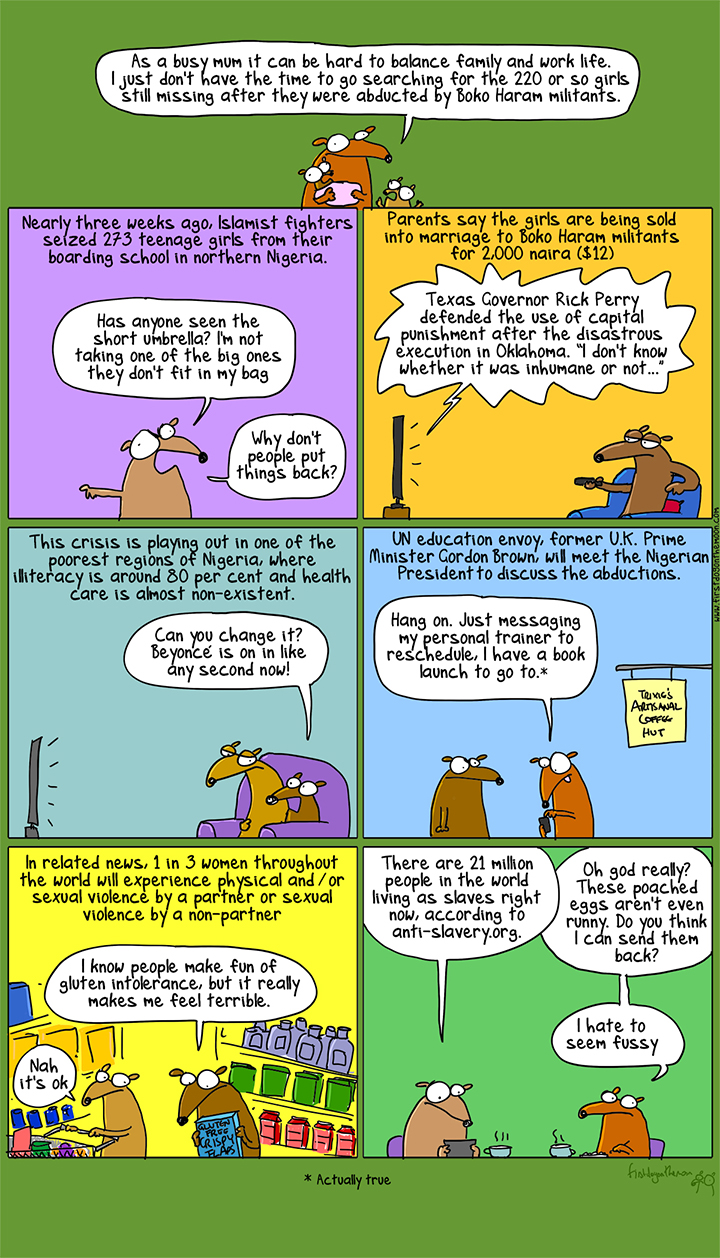
SATIRE - FIRST DOG ON THE MOON - NIGERIAN ABDUCTED GIRLS - ANALYTICAL ESSAY


How has the satirist used visual elements and language techniques to convey the message in this cartoon?

There is a world of difference between First World countries and Third World countries. First World countries control most of the world's resources, but do not see the need to empathise with Third World societies. It is becoming a commonplace saying today - 'That's a First World problem,' when people from rich nations complain about everyday 'issues' that displease them, not seeing that in comparison to Third World populations, their problems are small indeed. Take the recent abduction of 273 Nigerian schoolgirls, whose only crime was desiring an education, something taken for granted by First World populations. The media showed scant interest at the time in following this story, no First World governments demanded action to bring back the girls, and the story soon became forgotten. It is an unhappy fact that these girls are still missing, still to be returned to their families, still to be certified dead or alive. Yet the First World has all but forgotten them. Satire is a form of comedy that uses wit as a weapon to send a message to society, in this case, First World society. The satirist in the 'First Dog on the Moon' cartoon has mocked this situation by the clever use of satirical devices such as visual elements and language techniques, targetting First World society which does nothing, or very little, to assist Third World society. Visual elements such as juxtaposition and caricature have been used in each frame and language techniques such as verbal irony are evident in the text within the cartoon frames. The purpose of combining all these elements is to send the message that First World people need to use their resources to reach out to Third World people.

The visual element of juxtaposing First World problems and Third World problems side by side, the satirist has enhanced the message in the text that is - First World problems are very insignificant when compared to Third World problems. At the top of the first two frames are words stating the facts about the 273 Nigerian schoolgirls who were abducted, whilst underneath the 'news', is the 'dog' (representative of First World children) complaining about an umbrella. 'Why don't people put things  back?' is asked regarding the umbrella. Very much a First World problem when Nigerian families are asking 'Why don't they bring our girls back?' The priorities of First World populations is shown in the second frame where one of the small 'dogs' is asking for the news of the Nigerian girls to be turned off as he/she wants to watch Beyonce on television. This juxtaposition reveals the lack of interest in the abducted Nigerian girls. By the third frame, the readers get the message - no matter how brutal are the facts about Third World problems - 21 million in slavery is a big deal - in the First World how the eggs are done is more problematic. The satirist has cleverly used the visual element of juxtaposition to mock the follies and vices of First World populations who show little interest in the terrible situations people in Third World countries are experiencing right now.  

Caricature is a crucial visual element of satire. The exaggeration of situations and characters help to give the satirist's message more impact. The representation of the First World as 'dogs' could be seen as derogatory, as to call a person a 'dog' is a huge put down. It could be classed as a way to mock First World children. The caricature of these cartoon figures is effective, and much kinder than a realistic representation of people would have been. By using the 'dogs' to represent First World children, maybe the cartoonist was hoping to be less offensive, and therefore people would study the cartoon more closely. The big eyes could represent knowledge while the long noses often represent liars, derived from the Pinocchio story. By representing real-life situations in caricature, the author has gauged the impact of his message that First World people really do not care about Third World problems, no matter how dire these problems are. 

Verbal irony, a language technique,  is perhaps one of the strongest tools of satire and it is present in this cartoon. The type of verbal irony used in this satirical cartoon is one where comparisons and contrasts are used to create a visualisation for the reader. Throughout each cartoon frame, the satirist has positioned the reader to compare First World concerns with Third World concerns, with the result that the reader should see as vacuous any comments by the First World 'dogs'. It is ironic that in the first frame, the 'dog' is whining about his umbrella, where in a country that would dearly love to see rain, an umbrella would not be used. People would be outside lapping up the rain. It is also ironic that the same 'dog' should ask the question - 'Why don't people put things back?' Of course the reader thinks of the 273 Nigerian girls who haven't been 'put back' where they were found. It is a well-known fact that Beyonce is very important to teenagers in the First World. She has many fans and one can understand the First World child wanting to watch her on television. It is ironic that watching Beyonce is far more important than hearing the news about what is happening to the Nigerian girls and how many real problems the Nigerian children have - widespread illiteracy and virtually no health care. In the third frame, the 'dogs' are discussing 21 million people enslaved globally, yet the smaller 'dog' is only concerned with the status of his eggs - 'Do you think I can send them back?' This is of relatively little importance and very ironicaly when we think about the Nigerian girls who haven't been sent back home.

The satirist has conveyed a very strong message by comparing First World problems with Third World problems. The First World is the obvious target of the mocking satire which exposes the follies and vices of First World people who are represented as dogs. The visual elements and the language features underline the message in the cartoon. What can First World children learn from a cartoon such as this one? Perhaps remember that you are very privileged and be grateful for your good fortune in living in a First World country rich in resources, rather than in a Third World country which lacks even basic resources such as education, health care, water and most of all, freedom. If you are able, donate some money to alleviate their problems.  


Some suggestions if you want to help:

What To Do:
1. Remember your privilege and be grateful for your good fortune.
2. Speak about this and other uncomfortable topics.
3. Don't get sucked in to the bullshit that is broadcast nightly (usually around six o'clock).
4. Write to your local MP; tell them this topic is important to you.
5. Find out who is doing something about this; offer them a one-off donation.
6. Feel better for having done something.
7. Don't feel so overwhelmed that you can't do anything.
8. Get involved in a local group that does something constructive in your area.
9. Be kind.

http://www.theguardian.com/commentisfree/cartoon/2014/may/05/first-dog-nigeria-girls

RESPONSE: How does the cartoonist convey the message?

  • Who is the target?
  • What is the purpose?
  • What language techniques does the cartoon contain?
  • What visual elements does the cartoon contain?

Monday, May 19, 2014

AFFLUENZA - A MODERN DISEASE - CARTOON - SATIRE

142766 600 The Affluenza Defense cartoons

CONSIDER this cartoon using the three levels...Literal, Inferential and Evaluative...

LITERAL meaning -- What do you see? Who's in the picture? What are they doing?

INFERENTIAL meaning -- What do you INFER (understand) from this picture? What message is the satirist conveying? 

EVALUATIVE meaning -- Write your full evaluation/analysis of this text. What tools of satire/art has the satirist used to convey his message? What is the main message the author is converying and how does he/she do this? How has the satirist used position, size, colour etc to underline his message to convey who is powerful, who is powerless, who is marginalised, who is foregrounded?


Monday, February 24, 2014

SATIRE - NOTES - DEFINITION - TOOLS OF SATIRE

SOME NOTES ON SATIRE:

Satire is usually meant to be funny. Its greater purpose is often constructive social criticism, using wit as a weapon.

Direct social commentary via satire - the writer tackles serious issues, often incurring the wrath of the crowd (often the very people the satire is directed at - e.g. THE IMPORTANCE OF BEING EARNEST, OSCAR WILDE. (poking fun at the upper classes, a comedy of manners - outward respectability and conformity...keeping up appearances)

A writer is trying to tell humans how NOT to act.

When writing about satire, ask yourself -


  • what was the author's intention?
  • who/what is the target of the satire?
  • what language does the author use? What 'tone' does this create?
  • what specific tools of satire has the author used? (check list below)


TOOLS OF SATIRE


  • strong irony
  • exaggeration
  • parody
  • juxtaposition
  • comparison
  • analogy
  • double entendre/puns (The title: THE IMPORTANCE OF BEING EARNEST...)
  • subversion
  • reversal (depicts flaws in commonly-held attitudes that benefit one group over another)

Tuesday, February 18, 2014

THE IMPORTANCE OF BEING EARNEST - OSCAR WILDE - PLAYS - SATIRE - ESSAY


"The Importance of Being Earnest" as a Satire


            The Importance of Being Earnest is a short play written by Oscar 
Wilde, who lived during the Victorian Era. The play itself has a very 
deep meaning, criticizing the people of the Victorian Era, yet it seems quite 
trivial. However, people from the Victorian Era did not realize that they 
were the ones being criticized, since it was Wilde’s most successful 
work. This shows that Oscar Wilde was a very clever man, who 
managed to trick people, as he was well aware that people do not 
like to be lampooned. The Importance of Being Earnest is therefore 
a cleverly subversive criticism of the audience it was meant to entertain.
            The people of the Victorian Era were true hypocrites. To this day, 
people know the Victorian people were hypocrites; perhaps the rigid 
expectations of the Era gave them no choice. The people of the Victorian 
age are known for being “moralizers”. They felt like they had to lie all 
the time, but then when someone found out, they would try to find a 
way to escape. This kind of things happened especially among the 
middle class and the upper class and Wilde demonstrates this 
through the characters in the play, especially Algernon Montcrieff 
and Jack Worthing. Their reason for lying was they had no other way
 to keep their reputations. 
            Daily life during the Victorian Era was very restricted. In some 
ways, appearance also became a major concern for the people of 
the Victorian Era. Men had to restrain themselves from openly gambling, 
being unfaithful to their wives, or marrying below themselves. Algernon 
well knew that the Victorians were living a lie when he declared the 
English morals were no better than the French who were unfaithful to 
their wives all the time.
            To state his opinions in a satirical manner, Oscar Wilde used 
his skills in literary style. For example, he used puns. One of the 
examples of his puns would be the title of the book itself. “Earnest” 
in the title of the book, meaning very genuine and open, is a pun 
because Jack who pretends be Earnest, is not earnest at all. He 
pretends to be Jack in the city and Ernest in the country. This proves 
that Wilde wanted to show his audience that they were hypocrites 
because the way they acted in the public was different from the way 
they acted in their private lives.
            Another example of his skills in literary style would be 
epigrams and contradictions. He used epigrams throughout the book. 
One of the examples is the character Miss Prism. She said, “No married
 man is ever attractive except to his wife.” First of all, she states the 
obvious. However, married men can also be attractive to other women. 
Here, Wilde tries to attack marriage during that time. An example of his contradictions is the line of Algernon, “What a fearful liar you are, Jack.
 I have not been called back to town.” This is another form of hypocrisy, 
where Algernon seems to contradict himself. He lies to everyone about 
being his brother, Ernest. Now he says that Jack is lying that he has 
been called back to town. This proves that Oscar Wilde was a clever
 and witty man with critical thinking and hard opinions about the people 
of the Era he lived in.
            Oscar Wilde also used his characters as cleverly subversive 
symbols. One of the examples would be Jack. Jack himself is a 
hypocrite in many ways. He pretended to have a brother called 
Ernest, so that he is able to do whatever he wanted and still keeps 
his reputation. He considers many things a taboo subject to talk 
about, such as modern culture. This is the example of people who 
demanded respect, but wanted to do unrespectable things.
            Another significant character that shows hypocrisy is Lady 
Bracknell. She is a symbol of the upper class of the Victorian Era. 
At first she disagrees that Algernon should marry Cecily. However, 
when she finds out that she has “a hundred and thirty thousand
 pounds in the Funds”, she totally changes her mind when she says
 that Cecily is “a most attractive young lady”, now that she looks at 
her. This shows that Lady Bracknell only cares about money. She 
even thinks that her daughter’s and nephew’s partners should have 
wealth.
            The Importance of Being Earnest is truly an impressive work 
of Oscar Wilde. It is a clever book, a very subversive one too. It criticized
 the audience it was meant to entertain. The historical evidence of the 
Victorian Era supported this because they were hypocrites who needed 
to be criticized in the hope of bringing about change. Wilde criticized 
his audience by using clever literary style and hidden symbols in his 
characters. Therefore, the purpose of Wilde’s work, which was to criticize
 his hypocritical audience, was successfully achieved.   


http://felixessays.blogspot.com.au/2012/11/the-importance-of-being-earnest-as.html


Works Cited
“Victorian Age.”  Amicicg Altervista. 05 October 2012
Wilde, Oscar. The Importance of Being Earnest. Ed. Moliken, Paul, and Lisa Miller. Prestwick,
House ed. Clayton, Delaware, Prestwick House, Inc., 2006.

Tuesday, May 21, 2013

SATIRE - VOCABULARY

LEARN TO SPELL/FIND THE MEANING/USE IN SENTENCES
use these words in your analytical essay


satirical
political
significant
caricature
parody
ironical
technique
literature
constructive
juxtaposition
double entendre
elements
absurd
situations
contemporary
manipulative
fragmented
morality
objective
ridicule
recognise
expose
guise
hypocrisy
exaggeration
criticism
comparison
expression
incorporate
invective
entertainment
portrayal
foregrounded
lampoon
diverse
illustrate
humour
sarcasm
imitation
literary
follies
vices
virtues
shortcomings
society
analogy
allusion
Juvenalian
Horatian
influence
synonymous
espouse
inappropriate

Friday, May 17, 2013

MERCHANT OF VENICE - SHAKESPEARE - PLAY - SATIRE

IS THE MERCHANT OF VENICE A SATIRICAL PLAY?


The Merchant of Venice is a satiric play for several reasons. The entire play was set in favour of an audience that hated Jews and believed that even the most inhumane treatment was well-deserved. Labelled as "killers of Jesus Christ", the Jews were hated by Venetians; in this case,  the merchant Antonio, for charging usury and for being a Jew. Shylock the Jewish money-lender in the play, received harsh treatment from Antonio for being "thrifty". He disgraced Shylock publicly by speaking badly about him, calling him a "cut throat dog", spitting on his clothes and in his face and by kicking him like you would a stray dog. (Act One, scene Three). After all this, Antonio approaches Shylock about borrowing money to which Shylock replies, “Hath a dog money? Is it possible that a dog can lend three thousand ducats?"  Without remorse, Antonio, one of Shakespeare’s "protagonists" in the play, responds by telling Shylock, "I am like as like to call thee so again, to spit on thee again, to spurn thee too." 
Shylock again suffers abuse at the hands of Christians when his only daughter Jessica elopes with Lorenzo, Antonio's friend, taking from him; bags of ducats, jewels and precious stones, even his treasured turquoise ring, which he received from his wife before she died. He is mocked and ridiculed when Solanio, Antonio's friend, refers to him as "the dog Jew" and telling of how Shylock ran through the streets of Venice crying for his ducats and his daughter, with boys following mockingly. (Act two, Scene Eight).
Finally, the play is satiric because, having suffered all the things mentioned above, Shylock is taken to court and stripped of his dignity, his possessions and most importantly, his religion, when Portia, disguised as a lawyer, brilliantly accuses him of attempting to kill Antonio in the signing a bond that demands a pound of his flesh, should he forfeit his loan. Shylock was left dejected and ridiculed for his vice.     

http://www.enotes.com/homework-help/merchant-venice-satiric-play-give-good-reasons-279732

A Brief Evaluation of Comedy
 In
The Merchant ofVenice

    A successful comedy needs basic elements and ingredients to be distinguished. In addition, it should make allowance for the audience who judge it. In consequence of ideological and psychological make-up variations, a comedy could be defined as a tragedy and vice versa. Looking to The Merchant of Venice, we find that it is a tragic-comedy that raises serious questions disguised in parody and irony. To be able to realize comedy in the play, there are some elements that should be discussed.

    Once the word comedy comes to mind, the first thing to think of is laughter. In the play, there are many situations that make the audience laugh through parody, irony, misidentification and slapstick. Regarding the scène of Launcelot Gobbo Shylock's servant who decides to mock his father's blindness, we find a good deal of comedy. Launcelot plays the role of a clown; he raises laughter from his frequent misuse of words and exaggerated movements which is considered slapstick. In addition, we laugh at Gobbo who misidentifies his own son.

    Parody and irony exist strongly in many situations. One of them is the ring scene when Portia and Nerissa act as if they are shocked with their husband's abandonment of the rings and they refuse to believe that they were given to the lawyer and his clerk. Irony exists when Portia says that her husband is not like Gratiano who gave away his wife's ring. In fact, she was joking as she was the lawyer who took the ring. Audiences laugh at this scene knowing that the truth that Bassanio gave away his ring as well. Knowing the truth, Portia tried to play the fool on her husband and that is when irony arouses laughter.

    An element that standardizes the quality of a comedy is illogicality or fancy. As seen through the play, it is clear that there are many illogical events taking place. Firstly, the equivocal relationship between Antonio and Bassanio that leads to further complication. Secondly, the undiscoverable disguise of Portia and Nerissa in the court scene. Last, but not least, the funny happy ending when three happy married couples and a merchant who has his wealth back are found. All these events happen only in fancy and that is why the dues ex machine technique is used to end the play happily when an unexpected person, Portia, comes in the time of no hope and gets Antonio out of the hot water. All in all, it is fancy and illogicality that make the audience able to laugh.

    The type of character is also one of the important elements that help the audience to laugh. Comic characters are usually flat and sort of caricature with no parallel in life. This type gives the audience an emotional distance which enables them to laugh and not lose their identity as in a tragedy. A stark model of that is Shylock's character that is presented as another Jewish comic stock villain character. This Jew villain is wearing the famous Jewish gabardine, acting miserly, lending money in usury and having a cruel nature. Such make-up forbid identification and consequently forbid any sympathy towards Shylock, so he is laughed at.

    A question that is highly significant is: for whom is it a comedy? The Merchant of Venice was first presented in the 16th century England where Jews were tyrannized and patriarchy was dominant. As result, the play was pretty successful as the audience accepted the mocking on Jews and laughed at it heartily. Regarding Shakespeare's neutralization towards the patriarchal system, men and women laughed at the upside-down rolls of Portia and Bassanio. Back to our present time, the play won't receive a big success as comedy in many countries, especially those of Europe and America because of the anti-Semitic impeachments the play confronts. It would be accepted only in countries that have conflicts with the State of Israel, the home intolerant Jews.

    In conclusion, The Merchant of Venice has a great deal of comedy that manages to entertain the audience through a light-hearted plot.                          

 http://7laa2.tripod.com/
           
http://7laa2.tripod.com/imagelib/sitebuilder/layout/spacer.gif


Tuesday, May 14, 2013

SATIRE - POLITICAL CARTOONS - DECONSTRUCTING A POLITICAL CARTOON

Deconstructing a political cartoon on three levels -- literal, inferential and evaluative.


IS SATIRE JUST TRIVIAL COMEDY?

This 2012  political cartoon, drawn by Pope, one of Australia's foremost political cartoonists, includes excerpts from a famous colonial poem, My Country, by Dorothea McKeller. It targets and criticises the then Queensland Labor Government using the Premier, Anna Bligh, who had just lost government in a landslide victory for the opposition, the Liberal National Party, headed by Campbell Newman. Both political figures are caricatured in the cartoon, with a backdrop of the recent Queensland floods. The cartoonist uses satire to entertain readers in what could be seen as a trivial way, but it is trivial comedy for serious people, as it portrays negative views about the results of Anna Bligh's policies which have left her with many empty seats (in Parliament).

Most political cartoons lean towards the bitter and cutting  Juvenalian style of satire, rather than the Horatian witty, gentler style.. The poem, caricatures and backdrop combine to lampoon Bligh's foolishness, strongly criticising her flawed policies.

Many satirical techniques can be identified immediately through the visual effects of the cartoon -- exaggeration, parody and incongruity. Anna Bligh, the figure in the tree clinging for dear life, is the caricatured figure of a woman who has lost her hold on Queensland. Her features are exaggerated and easily recognisable. The message of the cartoon is that she desperately wants to save the seats for her party from the 'flood'. representing the votes from the citizens, whereas Campbell Newman is portrayed as being as happy as a 'fish' swimming freely in the water after receiving a 'flood' of votes.

As Australians, we can definitely tell that the poem written in the cartoon is a parody of the colonial era poem, My Country, once studied by every Australian school student. The original poem eulogises Australian landscapes, and this excerpt is a reversal of the original. It obviously criticises Anna Bligh for the way she liked to 'spin' policies to the Queensland people, but now the people are 'spinburnt.' Instead of 'sunburnt', the writer uses the technique of parody and replaces this word with 'spinburnt', which refers to how much Anna Bligh has used spin in political speeches, lying to the people about the true state of politics and policies in Queensland. Satire here is used as 'an antidote to being lied to', as John Clarke, well-known Australian comedian says. So the purpose behind Pope's cartoon is to expose the lies and spectacular defeat of Anna Bligh's government: 'Her stuff ups and her sell offs' have left her 'up a tree.' 

Further reference to the political cartoon shows the exaggeration of 'groaning' infrastructure which portrays her failed attempt to repair the damage caused by the Queensland floods, even though she put a positive spin on the rebuilding program during the floods. 

The cartoon may make a serious situation look trivial, and the Brisbane floods were anything but trivial, but Pope was exposing what he considered vice and folly in Bligh's government. His use of satire reveals his desire to denounce the Labor Government's reckless policies and applaud the change in society which began with Bligh's defeat.

Satire is a lesson, parody is a game, but it is a serious game, and Australians are free to satirise people and events as we see them without punishment. Satirists write texts both to entertain and educate readers with their comments and opinions about people and events in society, hoping to bring about change. The two satirical texts share this feature although they were written in two different eras. This political cartoon shows how satire is not just trivial comedy, it continues to bring about change in society by its message, using wit as a weapon. 

Tuesday, April 30, 2013

SATIRE - POLITICAL CARTOONS - ANALYSIS

SATIRE is a term applied to ANY work of literature or art whose objective is to RIDICULE. From ancient times satirists have shared a common aim - to expose foolishness in all its guises--vanity, hypocrisy, idolatry, bigotry etc -- and to effect reform through such exposure.


POLITICAL CARTOONS

  • Are a reflection and commentary on our DEMOCRACY.
  • They provide a SNAPSHOT of major events and personalities, often capturing the complexities of political action and public perception in a single image.
  • Serious subjects/issues are tempered by wit and wisdom of the cartoonists. (One definition of satire is 'wit as a weapon' which fits the political cartoon to a T.

DECONSTRUCTING POLITICAL CARTOONS

When  you look for meaning in a political cartoon, you need to examine it on 3 levels -- literal, inferential and evaluative.


EXERCISE
Study the political cartoon below. Write a few sentences on each level of reading -- literal, inferential, evaluative.


LITERAL meaning -- What do you see? Who's in the picture? What are they doing?

INFERENTIAL meaning -- What do you INFER (understand) from this picture? What message is the satirist conveying? 

EVALUATIVE meaning -- Write your full evaluation/analysis of this text. What tools of satire/art has the satirist used to convey his message? What is the main message the author is converying and how does he/she do this? How has the satirist used position, size, colour etc to underline his message to convey who is powerful, who is powerless, who is marginalised, who is foregrounded?


Go here for more political cartoons featuring the Australian Prime Minister, Julia Gillard as she goes about her daily business of governing Australians.

http://www.google.com.au/search?q=political+cartoons+julia+gillard&client=safari&rls=en&tbm=isch&tbo=u&source=univ&sa=X&ei=GU9_Ua6mC6uwiQeWwoHgCw&ved=0CDEQsAQ&biw=1024&bih=457

Remember that Australia is a DEMOCRACY (rule of the people by the people). We have the freedom to satirise anything. Not all countries are so generous with their freedoms. 


Thursday, April 25, 2013

SATIRE - THE ADVENTURES OF HUCKLEBERRY FINN - MARK TWAIN

How does Mark Twain utilise satire in "The Adventures of Huckleberry Finn"?
(I have highlighted satirical techniques)

In "The Adventures of Huckleberry Finn," Mark Twain uses satire to mock many different aspects of the modern world. Throughout his trip down the Mississippi River, and even prior to leaving St. Petersburg, Huck encounters a variety of people and situations that are designed to scoff at the American people.

"The Adventures of Huckleberry FInn" was written shortly after the Civil War, where slavery was one of the key issues. While Twain's father had slaves throughout his childhood, Twain did not believe that slavery was right. Through the character of Jim, and the major moral dilemma that followed Huck throughout the novel, Twain mocks slavery and makes a strong statement about the way people treated slaves. Miss Watson is revered as a good Christian woman, who had strong values, but she is a slave owner in the story. She owns a slave called Jim, who runs away upon hearing that Miss Watson might sell him to New Orleans. Rather ironic, don't you think?

Twain uses satire to show how hypocritical a "good Christian woman" can be when it comes to owning slaves as property. In the end, Miss Watson feels guilty for trying to sell Jim and gives him his freedom in her will. Of course, no one knows this until the very end of the novel, after all of the crazy schemes that Huck and Tom Sawyer concoct to help keep Jim out of slavery.

We see satire again in the novel through the idea of family feuds. The Shepardsons and Grangerfords are a pair of feuding families, and no one can remember why they are even fighting. The young Buck Shepardson Grangerford respects the Shepardsons, making it known that they are certainly not cowards, but that he wants to kill them so bad, though he hardly knows why. This feud is said to model one particular feud during the same time period between two families, the Hatfields and the McCoys. These two families had a huge feud that lasted for many years. There are a great deal of similarities between the fictional feud and the real feud. The fictional feud is satirical, in that it takes the happenings of the real feud and makes them seem pointless and silly, commenting on the stupidity of human nature.

Another example of satire that pokes fun at human nature is the Boggs and Sherburn incident. When Sherburn killed Boggs for continued harassment, the town felt the need to lynch Colonel Sherburn for his crimes. Sherburn comes out with a gun and crazily speaks to the mob. He preaches to them about their nature and how they wouldn't be able to stand against him if they weren't a group of people. As individuals, they were essentially cowards, and that they had no reason to be there to lynch him. Through Sherburn, Twain satirizes the idea of lynching and the human nature that goes along with whatever the crowd decides as opposed to what each individual thinks or believes. After his speech, the crowd walks away.

There are many examples of satire in "The Adventures of Huckleberry Finn." Through satire, Mark Twain shares his beliefs about slavery and human nature, among many other topics that plagued the country at the time.


http://classic-literature.yoexpert.com/read-and-study-books/what-are-some-examples-of-satire-in-%22the-adventure-644.html