Wednesday, June 11, 2014

SATIRE - FIRST DOG ON THE MOON - NIGERIAN ABDUCTED GIRLS - ANALYTICAL ESSAY


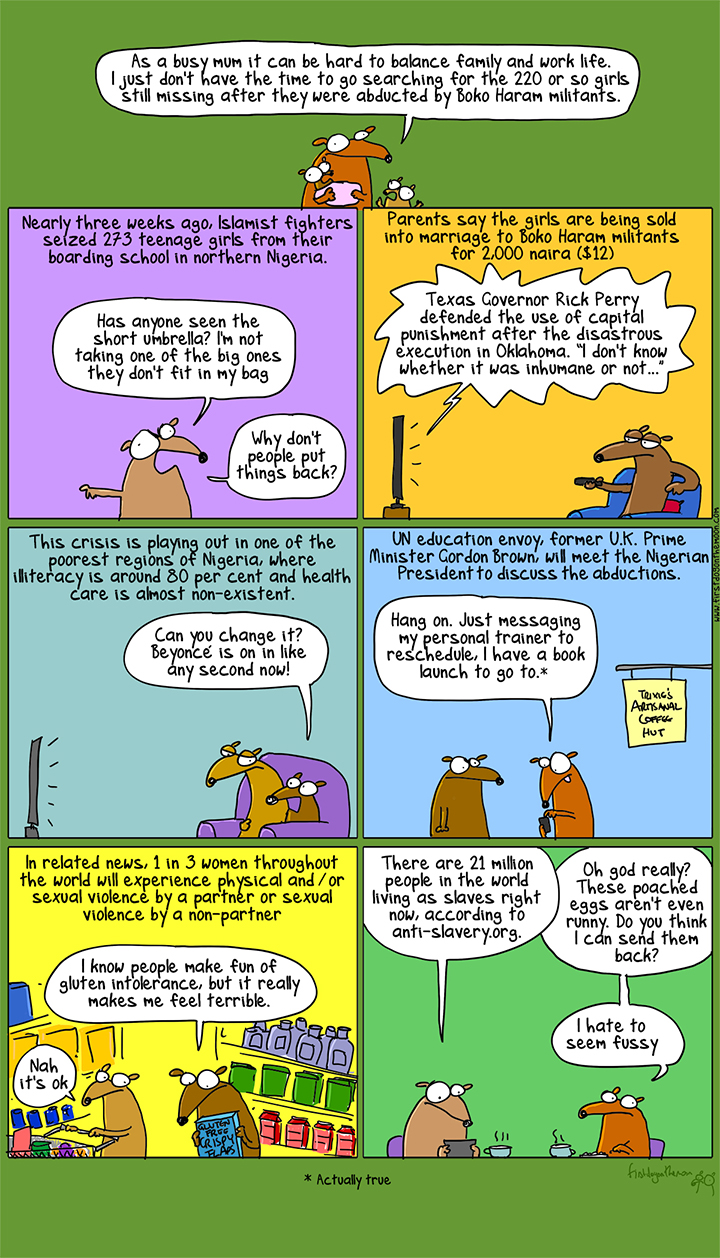
How has the satirist used visual elements and language techniques to convey the message in this cartoon?

There is a world of difference between First World countries and Third World countries. First World countries control most of the world's resources, but do not see the need to empathise with Third World societies. It is becoming a commonplace saying today - 'That's a First World problem,' when people from rich nations complain about everyday 'issues' that displease them, not seeing that in comparison to Third World populations, their problems are small indeed. Take the recent abduction of 273 Nigerian schoolgirls, whose only crime was desiring an education, something taken for granted by First World populations. The media showed scant interest at the time in following this story, no First World governments demanded action to bring back the girls, and the story soon became forgotten. It is an unhappy fact that these girls are still missing, still to be returned to their families, still to be certified dead or alive. Yet the First World has all but forgotten them. Satire is a form of comedy that uses wit as a weapon to send a message to society, in this case, First World society. The satirist in the 'First Dog on the Moon' cartoon has mocked this situation by the clever use of satirical devices such as visual elements and language techniques, targetting First World society which does nothing, or very little, to assist Third World society. Visual elements such as juxtaposition and caricature have been used in each frame and language techniques such as verbal irony are evident in the text within the cartoon frames. The purpose of combining all these elements is to send the message that First World people need to use their resources to reach out to Third World people.

The visual element of juxtaposing First World problems and Third World problems side by side, the satirist has enhanced the message in the text that is - First World problems are very insignificant when compared to Third World problems. At the top of the first two frames are words stating the facts about the 273 Nigerian schoolgirls who were abducted, whilst underneath the 'news', is the 'dog' (representative of First World children) complaining about an umbrella. 'Why don't people put things  back?' is asked regarding the umbrella. Very much a First World problem when Nigerian families are asking 'Why don't they bring our girls back?' The priorities of First World populations is shown in the second frame where one of the small 'dogs' is asking for the news of the Nigerian girls to be turned off as he/she wants to watch Beyonce on television. This juxtaposition reveals the lack of interest in the abducted Nigerian girls. By the third frame, the readers get the message - no matter how brutal are the facts about Third World problems - 21 million in slavery is a big deal - in the First World how the eggs are done is more problematic. The satirist has cleverly used the visual element of juxtaposition to mock the follies and vices of First World populations who show little interest in the terrible situations people in Third World countries are experiencing right now.  

Caricature is a crucial visual element of satire. The exaggeration of situations and characters help to give the satirist's message more impact. The representation of the First World as 'dogs' could be seen as derogatory, as to call a person a 'dog' is a huge put down. It could be classed as a way to mock First World children. The caricature of these cartoon figures is effective, and much kinder than a realistic representation of people would have been. By using the 'dogs' to represent First World children, maybe the cartoonist was hoping to be less offensive, and therefore people would study the cartoon more closely. The big eyes could represent knowledge while the long noses often represent liars, derived from the Pinocchio story. By representing real-life situations in caricature, the author has gauged the impact of his message that First World people really do not care about Third World problems, no matter how dire these problems are. 

Verbal irony, a language technique,  is perhaps one of the strongest tools of satire and it is present in this cartoon. The type of verbal irony used in this satirical cartoon is one where comparisons and contrasts are used to create a visualisation for the reader. Throughout each cartoon frame, the satirist has positioned the reader to compare First World concerns with Third World concerns, with the result that the reader should see as vacuous any comments by the First World 'dogs'. It is ironic that in the first frame, the 'dog' is whining about his umbrella, where in a country that would dearly love to see rain, an umbrella would not be used. People would be outside lapping up the rain. It is also ironic that the same 'dog' should ask the question - 'Why don't people put things back?' Of course the reader thinks of the 273 Nigerian girls who haven't been 'put back' where they were found. It is a well-known fact that Beyonce is very important to teenagers in the First World. She has many fans and one can understand the First World child wanting to watch her on television. It is ironic that watching Beyonce is far more important than hearing the news about what is happening to the Nigerian girls and how many real problems the Nigerian children have - widespread illiteracy and virtually no health care. In the third frame, the 'dogs' are discussing 21 million people enslaved globally, yet the smaller 'dog' is only concerned with the status of his eggs - 'Do you think I can send them back?' This is of relatively little importance and very ironicaly when we think about the Nigerian girls who haven't been sent back home.

The satirist has conveyed a very strong message by comparing First World problems with Third World problems. The First World is the obvious target of the mocking satire which exposes the follies and vices of First World people who are represented as dogs. The visual elements and the language features underline the message in the cartoon. What can First World children learn from a cartoon such as this one? Perhaps remember that you are very privileged and be grateful for your good fortune in living in a First World country rich in resources, rather than in a Third World country which lacks even basic resources such as education, health care, water and most of all, freedom. If you are able, donate some money to alleviate their problems.  


Some suggestions if you want to help:

What To Do:
1. Remember your privilege and be grateful for your good fortune.
2. Speak about this and other uncomfortable topics.
3. Don't get sucked in to the bullshit that is broadcast nightly (usually around six o'clock).
4. Write to your local MP; tell them this topic is important to you.
5. Find out who is doing something about this; offer them a one-off donation.
6. Feel better for having done something.
7. Don't feel so overwhelmed that you can't do anything.
8. Get involved in a local group that does something constructive in your area.
9. Be kind.

http://www.theguardian.com/commentisfree/cartoon/2014/may/05/first-dog-nigeria-girls

RESPONSE: How does the cartoonist convey the message?

  • Who is the target?
  • What is the purpose?
  • What language techniques does the cartoon contain?
  • What visual elements does the cartoon contain?

Tuesday, June 10, 2014

THE MERCHANT OF VENICE - ROMANTIC COMEDY?

Romantics and Merchants in The Merchant of Venice   


Shakespeare's comedies usually follow a clearly defined pattern. He presents a conflict, and the characters eventually resolve the conflict in a relatively happy ending, which involves marrying off the hero and his entourage to the heroine and her companions, leaving the villain outside the "magic circle" of protagonists. In TheMerchant of Venice, Antonio is presented as the hero, and Shylock the villain, but neither is within the circle of marriages at the end of Act V. In fact, Antonio's depression exposed at the beginning of the play seems unresolved at the end, and he goes on his melancholy way, as he supposes he must. Can The Merchant of Venice, then, be considered a true comedy? 

The strongest argument discounting Merchant as a true comedy is that though Antonio appears to be the major protagonist in the story, he is also as far outside the magic circle as his villain, Shylock. While Bassanio, Portia, and their associated parties marry off at the end of Act V, Antonio is left to his ships and his money, still going about his depressed way. At the beginning of the play, Antonio expresses hisdissatisfaction with his situation to his friends. "I hold the world but as the world, Gratiano, a stage where every man must play a part, and mine a sad one" (I.i.81-83). Throughout the play, and Shylock's relentless pursuit of his macabre repayment, Antonio remains in this dreary, defeated state. He seems almost too eager to end his suffering at the hands of his debtors and his apparently lost business. "Grieve not that I am fall'n to this for you," he tells Bassanio in court, "for herein Fortune shows herself more kind than is her custom: it is still her use to let the wretched man outlive his wealth, to view...an age of poverty, from which ling'ring penance of such misery doth she cut me off" (IV.i.278-284). He begs the court to make no more attempts to save his life, comparing such futile endeavors to abate the flood waters or question the wolf's killing of sheep (IV.i.71-84). Completely resigned to his grisly fate, he announces, "I am a tainted wether of the flock, meetest for death. The weakest kind of fruit drops earliest to the ground, and so let me" (IV.i.116-118). Even in Act V, after the dispute with Shylock is decided in Antonio's favor, the melancholy merchant plays no role in the resolution of the play. While Portia and Nerissa play trickeries with their respective grooms, Antonio despairingly states, "I am th'unhappy subject of these quarrels" (V.i.254). Even at the end, when in barely passing mention Portia informs Antonio of the favorable fate of his merchant fleet, he simply thanks her and falls silent once more. No customary "happy ending" awaits Antonio at the end of the play, as it does the rest of the Christians in Venice. 

The argument against Merchant's comedic nature loses sight of the parts of the play which do fit Shakespeare's customary pattern. Bassanio and Portia, the subjects of Merchant's other major plot, do experience the happy ending fit for a Shakespearean comedic hero and heroine, and are at the center of the magic circle at the end. Their meeting and marriage in Belmont traces a fairy-tale-like path through the minefield of disputes over Portia's father's conditions for her marriage. Bassanio's almost whimsical (but successful) attempt at the three chests is a fantastical, romantic tale which plays itself out far removed from the troubles in Venice. When those characters return to the city, that magical, fantastic atmosphere comes with them, providing for Antonio's sudden rescue by the wily Portia and Nerissa. Both of these women from Belmont fit Shakespeare's common "strong woman" archetype, which he uses in other comedies (like Viola in Twelfth Night). The magic circle does form around most of the protagonists, and Shakespeare throws six bachelor characters at each other and ends up with three married couples with the full intention of living happily ever after. There, the restraining forces on those marriages -- namely, Antonio's bond, Jessica's religion, and the husbands' forfeiture of their rings -- are all lifted, and the comedy comes to its expected conclusion. Likewise, Shylock, the blatantly evil villain of the play, is accordingly shunned from the magic circle and left to his own devices, stripped of his money, his assets, his daughter, his bond with Antonio, his Jewish faith, and his dignity as a Venetian merchant. Shylock is completely bereaved of everything he holds dear, and is completely excluded from the fairy tale's conclusion in Act V. Such a treatment befits the villain of a comedy. Considering these facts, and excluding the problem of Shakespeare's treatment of Antonio, The Merchant of Venice stands as a near-perfect example of Shakespeare's comic pattern. 

However, the question still remains: What about Antonio? If he really is the hero of the play, and if Shakespeare's comedies are always to end on a happy tone, can The Merchant of Venice really be considered a true comedy, leaving Antonio as melancholy and alone as he began? The argument against discounting Merchant as a comedy derives its strength from the fundamental difference in the play's protagonists and their placement in the dual settings, Venice and Belmont. The suitors' relentless pursuit of Portia in Belmont, the contract of the three chests drawn up by her dead father, Bassanio's magical inspiration to pick the right chest, and Belmont's inherent obscurity (neither Shakespeare nor any of his characters give any indication as to Belmont's actual geographic location) all enhance its fantastical, romantic, fairy-tale atmosphere. Love and marriage are not the main concerns of the people of Belmont; rather, love and marriage are their only concerns. Therefore, all those characters who are married at the end of Act V have some sort of association with Belmont and its inhabitants, and their "happy ending," which could only involve marriage to their predestined spouses, is fully realized. Antonio and Shylock, however, have no association with the land of Belmont; they are cold, calculating merchants of Venice. Their sole concern is not love or marriage or any sort of romantic destiny; it is the pursuit of profitable ventures in the markets of Venice. Shylock goes so far as to miss his ducats before his daughter when both disappear, and takes only delight in Antonio's losses at sea (III.i). For the characters in Venice, then, the only way to banish Shylock the villain from society and provide for Antonio the happy ending he deserves as the hero is to use money, not marriage, as the measure of success. Already stripped of his daughter, Shylock can only be punished by depriving him of his money. "Take my life and all," Shylock hisses at the court. "You take my house when you do take the prop that do sustain my house; you take my life when you do take the means whereby I live" (IV.1.390-393). Whereas Portia lives only to be married, Shylock lives only to make money as a merchant of Venice, so separating him from his money is as effective a treatment as a villain as separation from loved ones normally is. Likewise, the resolution of Antonio's conflict comes with his release from Shylock's bond and the news that his ships have safely reached port (V.i.292-298). Thus while everyone else enjoys their marriages, Antonio receives the greatest blessing that his native Venice can give him: the safety of his assets. "Sweet lady," Antonio proclaims, "you have given me life and living; for here I read for certain that my ships are safely come to road" (V.i.306-308). Though it receives only passing mention, the success of Antonio's ships is as important a resolution as the marriages are to the couples. The Merchant of Venice provides for the customary treatment of its heroes and villains by shifting the focus from romantic to economic success for those characters who remain in Venice. Though it does not strictly fit the pattern of Shakespeare's other comedies, The Merchant of Venice remains a comedy by using its two different settings to produce two distinct goals for its heroes to reach, thereby providing for a happy ending for all the protagonists. 

THE MERCHANT OF VENICE - ANALYTICAL ESSAY - THE COURT SCENE

How does the trial scene in The Merchant of Venice demonstrate the triumph of good over evil as order is restored from chaos.

SOME BACKGROUND ON THE MAIN ASPECTS OF THE TOPIC, THEN...

The trial scene in the Merchant of Venice is the chaotic climax of the play as Shylock, the Jew, has 
taken Antonio to court, as due to losing his ships, he has not paid back the money he borrowed to assist his best friend Bassaino's wooing of Portia of Belmont.  Even though there are those in the court willing to pay back the bond triple fold, Shylock wants the pound of flesh that is the forfeit of the bond concerning the money Antonio borrowed from him.  Other than his hatred for Antonio and Christians, Shylock’s main motivation for wanting this forfeit is as his daughter has stolen his money and run away, he is taking out his spite on Antonio and this blinds him as he does not watch what he is getting into during this scene. Shylock's actions label him as the evil character, while all others are portrayed as good.

From the point where Shylock enters the courtroom everyone opposing him is appealing for mercy for Antonio and this is what the scene demonstrates, a need for mercy.  Portia, who has disguised herself as a young legal advocate says shortly after she has entered the scene: ‘Then the Jew must be merciful’ she is not saying that this is what the law says he must be, but that he should do this because it is the only thing he can do morally. Portia is speaking from the Christian perspective where it would be expected that the complainant would show mercy.  The mercy theme runs all the way through the scene and many opportunities were offered by the Duke of Venice, Bassanio and Portia for Shylock to take the moral course of action, but he constantly refuses saying he should get what he deserves not by moral justice but by the law. 

Shylock does have the right to the forfeit of his bond and it is Antonio’s fault that he is in this situation because he signed the bond of his own free will. even though warned against it.  He knew the consequences if he couldn’t pay it back as Shylock made it clear from the start, but Antonia, in the throes of depression, signs anyway.  This is shown by when at the start of the court scene when Antonio says: ‘Make no more offers use no farther means, but with all brief and plain conveniency let me have judgement, and the Jew his will’.  When he did not pay Shylock the money he owed him, Shylock had a right to Antonio’s forfeit by law.  The problem was he did not choose the moral path where he probably could have gotten a lot of money and become a very rich man, but chose the forfeit out of spite over his daughter. 

This theme is also repeated through the scene that Shylock deserves his justice by the letter of the law and the forfeit of his bond.  This is shown when he says phrases like ‘My deeds upon my head I crave the law, the penalty and forfeit of my bond’.  Portia lets Shylock have the chance to take the moral path or the letter of his bond and Shylock chooses to have his pound of flesh.  Shylock does not realise he is being played into a trap as he is blinded by spite, so by choosing the forfeit of the bond he is also choosing execution or to have all of his estate forfeit by the letter of the law he so craved.  This means Shylock has been tricked into choosing a certain course of action and he did not know of the consequences until after his decision. Shak

Portia plays on this drawing him further and further towards the inevitable knowing he is stumbling blinded by spite towards a consequence that he is not expecting.  This is the point when the balance of power in the trial changes.  Portia has an obvious knowledge of the law as she is using it to trap him, Shylock has no representation and obviously has little knowledge of the law as he puts up little argument. 

This results in an ironical justice.  Portia, after Shylock has chosen his course of action, informs him of the consequences, she says ‘If thou dost shed one drop of Christian blood, thy lands and goods are by the laws of Venice confiscate unto the state of Venice’. Antonio receives his moral justice and Shylock is shown little mercy by the letter of the law that he demanded for himself.  As Shylock refused to show mercy to Antonio when he had power over him, he is shown the same treatment and apparently gets what he deserved as he is shown no mercy.  Shylock tries to go back and get the money he earlier refused to take but Portia stops him by saying ‘The Jew shall have all justice, he shall have nothing but the penalty.’ It is shown to the reader that Shylock gets what is due as the play is written in favour of Christianity, and so all sympathy is lost for Shylock.  This is because of the way he is taking his anger out on Antonio, because of his daughter stealing his money and running away.  Also he doesn’t care that his daughter has run away only that she has stolen his money. 

This demonstrates a prejudice towards him as a Jew and so none of his characters like him because of his religion and one of the consequences of the course of action he has chosen is that he is forced to become Christian.  In the end the reader is shown that justice is carried out as Antonio and Bassanio are good Christian people and so good has triumphed over the immoral Jew, Shylock. Order has been restored from chaos.

http://www.123helpme.com/view.asp?id=3809

Monday, June 2, 2014

SATIRE - CARTOONS - ENVIRONMENT - CLIMATE CHANGE - GLOBAL WARMING


CONSIDER these cartoons using the three levels...Literal, Inferential and Evaluative..

.
LITERAL meaning -- What do you see? Who's in the picture? What 

are they doing?


INFERENTIAL meaning -- What do you INFER (understand) from 

this picture? What message is the satirist conveying? 


EVALUATIVE meaning -- Write your full evaluation/analysis of 

this text. What tools of satire/art has the satirist used to convey his 


message? What is the main message the author is converying and 

how does he/she do this? How has the satirist used position, size, 

colour etc to underline his message to convey who is powerful, who 


is powerless, who is marginalised, who is foregrounded?


WRITE a P.E.E.L paragraph on one/both of the cartoons,  

seamlessly incorporating the three levels of meaning. 


***************


It will look more like a P. E.E.E.E.E.E. L paragraph:


POINT

______________________________________________________________________________________________________________


EXPLANATION/ELABORATION - Literal meaning

____________________________________________________________________________________________________________________________________________________________________________________________________________________________


EVIDENCE - from cartoon 


____________________________________________________________________________________________________________________________________________________________________________________________________________________________


EXPLANATION/ELABORATION - Inferential meaning


____________________________________________________________________________________________________________________________________________________________________________________________________________________________


EVIDENCE - from cartoon re MESSAGE

____________________________________________________________________________________________________________________________________________________________________________________________________________________________


EXPLANATION/ELABORATION - Evaluative meaning
____________________________________________________________________________________________________________________________________________________________________________________________________________________________


EVIDENCE - from cartoon re TOOLS OF SATIRE

____________________________________________________________________________________________________________________________________________________________________________________________________________________________


LINK - link back to your POINT (Opening sentence)


______________________________________________________________________________________________________________


Tuesday, May 27, 2014

SOCIAL MEDIA - EFFECTS OF - ACTIVITY

The Impact of Social Media on Children, Adolescents, and Families
1.       https://encrypted-tbn1.gstatic.com/images?q=tbn:ANd9GcSxua3nGuF8jerVgdjDMWA05iWBVRM-G2ONR2hKv6gtOn7m36e5Gwenn Schurgin O'Keeffe, MD
2.       Kathleen Clarke-Pearson, MD
3.       Council on Communications and Media
Using social media web sites is among the most common activity of today's children and adolescents. Any web site that allows social interaction is considered a social media site, including social networking sites such as: Facebook, MySpace, and Twitter; gaming sites and virtual worlds such as Club Penguin, Second Life, and the Sims; video sites such as YouTube; and blogs. Such sites offer today's youth a portal for entertainment and communication and have grown exponentially in recent years. For this reason, it is important that parents become aware of the nature of social media sites, given that not all of them are healthy environments for children and adolescents. Families are urged to understand these sites and to encourage healthy use and parents are urged to monitor for potential problems with cyberbullying, “Facebook depression,” sexting, and exposure to inappropriate content.
AFTER READING THE ARTICLE, ANSWER THESE QUESTIONS
1.      In your experience would you agree with the authors’ statement in the first sentence? Explain your answer…
___________________________________________________________________________________________________________________________________________________________________________________________________________________________________________________
2.      Give three examples of social media sites.
__________________________________________________________________________________
3.      What is your favourite social media site. Give reasons.
__________________________________________________________________________________________________________________________________________________________________
4.      Why do the authors suggest that social media sites are so popular with adolesents? Do you agree or disagree? Give reasons.
___________________________________________________________________________________________________________________________________________________________________________________________________________________________________________________
5.      Parents are advised to be aware of social media sites. Why? Do  you agree/disagree?
___________________________________________________________________________________________________________________________________________________________________________________________________________________________________________________
6.      What specific problems are families urged to monitor for? What do you know of these problems?

___________________________________________________________________________________________________________________________________________________________________________________________________________________________________________________

Monday, May 26, 2014

POLITICAL CARTOONS - SATIRE - EVALUATING CARTOONS

Given that the simple definition of SATIRE is 'the use of ridicule to mock and expose, in particular, folly or falsity', analyse each cartoon in terms of this definition.

Examine each cartoon on the literal (what do you see?), inferential (what is the message?) and evaluative levels (what tools has the author used to send the message?).


The Australian, 26/5/2014


Behind the lines - the year's best political cartoons 2011


A P.E.E.L paragraph evaluating the above cartoon using the three levels of meaning.

POINT: This cartoon is an excellent example of satire using ridicule to expose a current issue in society. LITERAL MEANING: The Cox&Forcum cartoon has used the everyday situation of friends leaving the movie theatre after seeing a movie, one clutching a drink in his hand. INFERENTIAL MEANING: It is the movie itself, The Day After Tomorrow, Environment Apocolypse, that creates the central message for the reader, that environmental activists may be reaching their use-by date because of their flawed attitude to humanity. EVALUATION: The satirist assumes the viewer knows this movie with its apocalyptic ending - the end of the world. The humor is found through the symbolic T-shirts the friends are wearing - one proclaims 'Earth First' while the other states 'Green Peace'. Once again the satirist assumes that those reading this cartoon know that these are real-life names of environmental activist groups who fight people and groups who they believe are ruining the environment. Perhaps the Green Peace activist with his non-degradable drink container just adds irony to the situation of saving the earth. The use of reversal where both activists bemoaned the ending because 'the humans lived', creates a chuckle, while at the same time revealing the satirist's attitude towards environmental activist groups like those represented in the cartoon. By using a pun of the subtitle of the movie, 'Environmental Apocolypse', the satirist is suggesting that maybe environmental activists are coming to an end. The satirist is suggesting that deep down environmental activists hate human beings, seeing them as a problem that needs to be eliminated. The cartoonist obviously values human life above the environment, or perhaps sees that eliminating human beings won't solve the earth's problems. By the use of irony, the satirist has successfully sent a message to society that perhaps society needs to rethink environmental activists regarding their attitude to humanity.   


Friday, May 23, 2014

OTHELLO - SHAKESPEARE - PLAY - OTHELLO - ALLEGORY

There are many animalistic references in the play. The easily-recognised denigrations that Iago uses when referring to Othello early in the play as a

Not so obvious is what happens after Desdemona's murder at the hand of Othello. Here Shakespeare uses allegory to show the depth of depravity that has taken place.

When Iago's schemes are at last exposed, Othello, finding it impossible for a moment to believe that a man could have contrived such evil, stares at Iago's feet and then says sadly, 'but that's a fable.' (Act 5, Scene 2).* What he hopes to find when he looks down are the cloven hoofs of the devil, and had they been there he would have been an actor in a morality play, tempted beyond his strength like many a man before him, by a supernatural power outside himelf.

The whole play can be seen a morality play, offering an allegorical journey between heaven and hell on a stage filled with purely symbolic figures.

But...Othello does not see the cloven hoofs when he looks down; he sees a pair of human feet at the end of a very human body; and Othello is forced to realise that far from living in some simplified 'fabulous' world where evil is a metaphysical power raiding human life from without, he dwells where evil is somehow inextricably woven with good into man himself. On this stage, however, the good angel does not return to heaven when defeated, but is murdered and her body remains on the bed, 'cold, cold.'

Shakespeare's plays are both allegorical and realistic at the same time. His characters are both recognisable men and at the same time devils, demigods, and forces in nature.

In Othello, Desdemona represents one particular human value, love or charity - no tragic flaw in her lead to her death. Her love and charity are shown in her actions, language and emotions. She is Shakespeare's word for love.  


*As though he were a judge, Lodovico calls Iago forth to stand beside his victim, Othello. Othello says of Iago, "I look down towards his feet; but that's a fable. / If that thou be'st a devil, I cannot kill thee" (5.2.286-287). Then he swings his sword at Iago, wounding him. The "fable" which Othello mentions is the one that says that devils have cloven feet. Because it's only a fable, Othello can't tell if Iago is a devil by looking at his feet, so he swings his sword at Iago, to see if he's human and can be killed. Othello's thought may seem strange, but we ought to remember that it wasn't too many minutes ago that Othello thought Iago the most honest man in the world. The transformation of Iago from honest friend to dishonest villain may easily seem devilishly unnatural.

http://www.shakespeare-navigators.com/othello/S52.html